
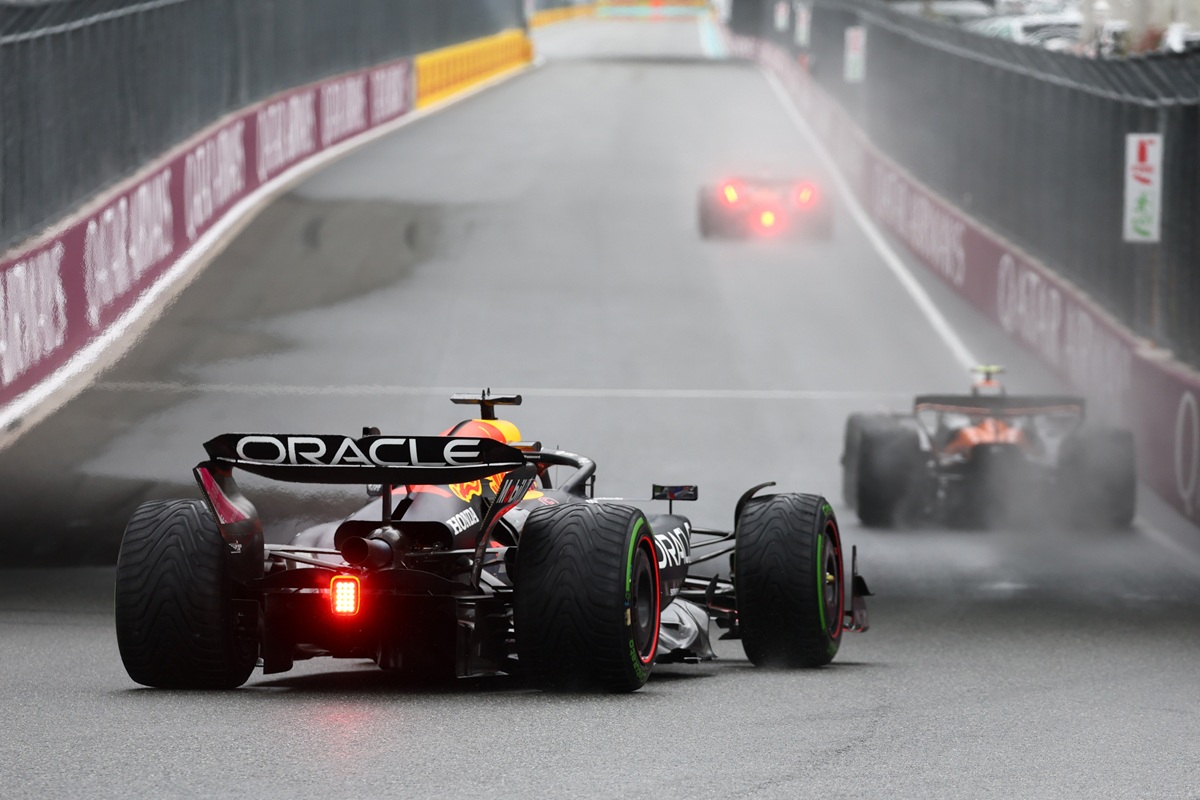
Lando Norris delivered the statement drive McLaren needed in the Miami GP Sprint, converting pole position into a controlled win ahead of team-mate Oscar Piastri and Ferrari’s Charles Leclerc.
This was a Sprint victory, not the full Miami Grand Prix win. The Grand Prix was held the following day and was won by Mercedes’ Kimi Antonelli.
For more Formula 1 reaction and race analysis, follow our F1 coverage. You can also keep up with the latest sports news and our growing sports guides and features across World In Sport.
Norris did not need chaos, luck, or a late-race twist. He got the start right, kept the lead into Turn 1, and then built the gap while the cars behind him fought for position. By the end of the 19-lap Sprint, McLaren had a one-two finish, Norris had claimed his first race-format win of the 2026 season, and the team had ended Mercedes’ early-season run of race-format wins. Formula 1’s official report listed Norris ahead of Piastri and Leclerc, with George Russell fourth and Max Verstappen fifth after Kimi Antonelli was penalised for track limits.
Miami GP Sprint result at a glance
| Position | Driver | Team | Gap | Points |
|---|---|---|---|---|
| 1 | Lando Norris | McLaren | 29:15.045 | 8 |
| 2 | Oscar Piastri | McLaren | +3.766s | 7 |
| 3 | Charles Leclerc | Ferrari | +6.251s | 6 |
| 4 | George Russell | Mercedes | +12.951s | 5 |
| 5 | Max Verstappen | Red Bull | +13.639s | 4 |
| 6 | Kimi Antonelli | Mercedes | +13.777s | 3 |
| 7 | Lewis Hamilton | Ferrari | +21.665s | 2 |
| 8 | Pierre Gasly | Alpine | +30.525s | 1 |
How did Lando Norris win the Miami GP Sprint?
The answer is simple: he controlled the race from the first corner.
Norris started from pole and made the clean launch he needed. In Sprint races, the first few hundred metres often decide the shape of the afternoon. There is less time to recover than in a full Grand Prix. There are fewer strategic options. Track position matters even more.
Norris understood that and did not leave the door open. Once he reached Turn 1 in front, the race became about rhythm, tyre control, and avoiding mistakes. Piastri stayed close enough to keep McLaren comfortable, but not close enough to put Norris under real pressure.
That gave McLaren the perfect race structure. Norris led. Piastri protected second. Leclerc had to balance chasing Piastri with keeping the Mercedes and Red Bull fight behind him under control. Behind them, Antonelli, Russell, Verstappen, and Hamilton fought their own battles.
The official Formula 1 Miami Sprint report noted that Norris “never looked back” after converting pole into the lead, while Piastri and Leclerc followed him home. It was one of those Sprint wins that looked calm because the hard work had already been done.
McLaren’s one-two sends a clear message
This was not just a Norris win. It was a McLaren result.
A one-two finish in a Sprint may not carry the same weight as a Grand Prix victory, but it still matters. It gives points. It lifts the garage. It proves upgrades are working under race pressure. It also gives both drivers proof that the car has a wider operating window than it may have shown earlier in the season.
Norris called it a good race and praised the team’s upgrades after the Sprint, saying the changes had helped McLaren across the weekend. He also made it clear that the main race still had to be handled properly.
That balance is important. McLaren could enjoy the moment, but it could not treat the Sprint as job done. The Sprint came before Sunday’s Miami Grand Prix, where Kimi Antonelli went on to win for Mercedes ahead of Norris and Piastri. Still, this was the first time in 2026 that Mercedes had been properly stopped in a race format, and that changes the mood of the championship fight.
For Norris, it was also a personal reset. A driver can talk about pace, progress, and potential for only so long. At some point, results must follow. In Miami, they did.
Why Oscar Piastri’s second place mattered too
Piastri’s second place should not be ignored.
He did not win, and he did not seriously trouble Norris once the race settled down. Yet his role in the McLaren one-two was vital. He kept Leclerc behind, gave the team maximum control at the front, and helped turn a strong Norris result into a team-wide statement.
In a season where fine margins can shape the constructors’ standings, those extra points matter. Piastri’s seven points meant McLaren took 15 from the Sprint alone. That is a strong return from a short race.
It also kept pressure on the teams around them. Ferrari still scored well through Leclerc and Hamilton. Mercedes still had Russell and Antonelli inside the points. Red Bull still had Verstappen fifth. But McLaren took the biggest prize from the Sprint, and they did it without relying on retirements or safety cars.
Antonelli’s penalty changed the lower order
Kimi Antonelli had another eventful outing. The Mercedes driver started second but lost ground at the start, dropping behind Piastri and Leclerc. He later fought with team-mate George Russell, recovered position on track, and crossed the line fourth.
However, a track limits penalty changed his final result. Antonelli dropped to sixth, which promoted Russell to fourth and Verstappen to fifth. That swing mattered because Sprint points are tight. One penalty can cost more than just a position. It can also shape the championship picture.
Sky Sports also reported that Antonelli dropped from fourth to sixth after a five-second penalty, while Norris took his first win of the 2026 season and McLaren completed a one-two. Their Miami GP Sprint report underlined how costly that decision was for Mercedes.
Leclerc gives Ferrari a useful podium finish
Charles Leclerc finished third, and while Ferrari will always want more, this was still a useful Sprint result.
Leclerc started near the front, stayed in the fight, and brought home six points. He could not match McLaren’s pace across the full Sprint, but he was quick enough to keep the pressure on Piastri and stay ahead of the Mercedes and Red Bull fight behind him.
For Ferrari, the bigger question is whether Miami showed a short-run strength or a real step forward. Sprint races can flatter some cars. They can hide long-run tyre issues. They can also reward a strong starting position more than outright race pace.
Even so, Ferrari had both cars in the points, with Hamilton finishing seventh. That gave the team something to build on, even if McLaren looked sharper at the front.
Verstappen and Hamilton add the edge behind the leaders
Max Verstappen and Lewis Hamilton were not fighting for the win, but their battle added bite to the Sprint.
The pair went wheel-to-wheel early on and again later in the race. Verstappen eventually finished fifth after Antonelli’s penalty was applied, while Hamilton came home seventh for Ferrari.
It was a reminder that even when the lead battle is settled, the midfield and front-pack fights can still shape the story. In a Sprint, every overtake matters. Every point matters. Every penalty matters.
For Red Bull, fifth was damage limitation rather than a breakthrough. Verstappen scored points, but he was not in the lead fight. For Hamilton, the result at least added to Ferrari’s total, though seventh was not the kind of finish he would have wanted after being in close combat with Verstappen.
Why this Sprint win matters for the 2026 F1 season
The Miami GP Sprint result matters because it changed the tone of the season.
Before Miami, Mercedes had set the early pace. Antonelli and Russell had looked like the benchmark pairing. McLaren had promise, but promise is not enough in Formula 1. Miami gave Norris and McLaren a result they could point to and say: we are back in the fight.
It also showed that McLaren can execute when the pressure is on. Sprint weekends compress everything. Teams get less practice time. Drivers have fewer chances to find a rhythm. A poor qualifying session can ruin the Sprint. A poor start can undo the weekend before it has properly begun.
Norris handled each part. Pole. Start. Control. Win.
That is why this result felt bigger than eight points. It was a message to Mercedes, Ferrari, and Red Bull that McLaren’s 2026 campaign had properly started.
Was this Norris’ best drive of the season?
It was certainly his cleanest.
There are more dramatic wins. There are wins with late overtakes, mixed weather, safety cars, and bold strategy calls. This was not that kind of race. This was a driver doing the basics at a very high level and not giving anyone a chance to disrupt him.
That should not be undervalued. In modern F1, a controlled win often says more about a driver’s confidence than a chaotic one. Norris did not need to fight back. He did not need to rescue the race. He simply made sure nobody else got close enough to complicate it.
The result also helped answer one of the key search questions fans will have after the weekend: Did Norris win because of McLaren’s pace, or because others made mistakes?
The answer is both, but mostly the first. Antonelli’s penalty affected the order behind him. Hulkenberg’s pre-race issue removed one car from the contest. Yet none of that decided the win. Norris was already clear.
McLaren’s upgrades pass their first big test
The most important part of the weekend for McLaren may not be the trophy. It may be the confirmation that the car improvements worked.
Teams often bring upgrades with confidence. The harder part is proving them under race conditions. Miami gave McLaren that proof. The car looked strong in clean air, stable across the Sprint distance, and quick enough to keep Ferrari and Mercedes at arm’s length.
Norris’ comments after the race suggested the team felt the same. He praised the work behind the upgrades and said they had made a clear difference. That is the kind of driver feedback teams want when they are fighting at the front.
The next task is repeatability. A fast car in Miami must still work at different track types. Street circuits, high-speed layouts, tyre-heavy venues, and cooler European rounds will all ask different questions. But a one-two Sprint finish gives McLaren confidence that the direction is right.
What comes next for Norris and McLaren?
For Norris, the challenge is turning a Sprint win into a sustained title push.
One strong Saturday can change headlines, but a championship is built across Sundays. McLaren will know that. Norris will know it, too. The pace is there, but the team must keep converting speed into results.
For Piastri, the target is to close the gap to Norris when McLaren are in winning shape. Second place was valuable, but if McLaren continue to produce front-running cars, both drivers will expect chances to win.
For Mercedes, Antonelli’s penalty was a frustration, but the car still looked competitive. Russell’s fourth place kept him in the points mix. For Ferrari, Leclerc’s podium kept them relevant. For Red Bull, Verstappen’s fifth showed they still had work to do.
That is what made the Miami Sprint so useful. It did not settle the season. It made it more interesting.
Final verdict: Norris makes Miami count
Lando Norris needed a clean weekend. McLaren needed proof. Miami gave both.
The Sprint win was not wild, lucky, or dramatic. It was measured, fast, and mature. Norris started first, stayed first, and finished first. Piastri followed him home to make it a McLaren one-two, while Leclerc completed the podium for Ferrari.
In a short race, that is as complete as it gets.
The Miami GP Sprint may not decide the 2026 Formula 1 season, but it could be remembered as the day McLaren properly joined the fight. For Norris, it was a reminder of what happens when pace, confidence, and execution all come together.
And for the rest of the grid, it was a warning.
McLaren are no longer waiting for the season to come to them. They have started chasing it.