
For all the technological advances in football, the English Premier League still finds itself trapped in an old problem: refereeing inconsistency. The arrival of Video Assistant Referee (VAR) was supposed to eliminate “clear and obvious errors.” Instead, it has created a new era of confusion where supporters, players, managers, and pundits leave matches debating officials rather than football.
Sunday’s controversial moment in West Ham United vs Arsenal F.C. may become one of the defining refereeing flashpoints of the 2025-26 Premier League season.
With Arsenal clinging to a narrow 1-0 lead thanks to a late strike from Leandro Trossard, West Ham thought they had rescued a priceless point in stoppage time when Callum Wilson bundled home from a corner kick. The West Ham United bench erupted. Their fans exploded in celebration. For a club fighting for survival, the goal felt like oxygen.
A Hammer Blow From VAR
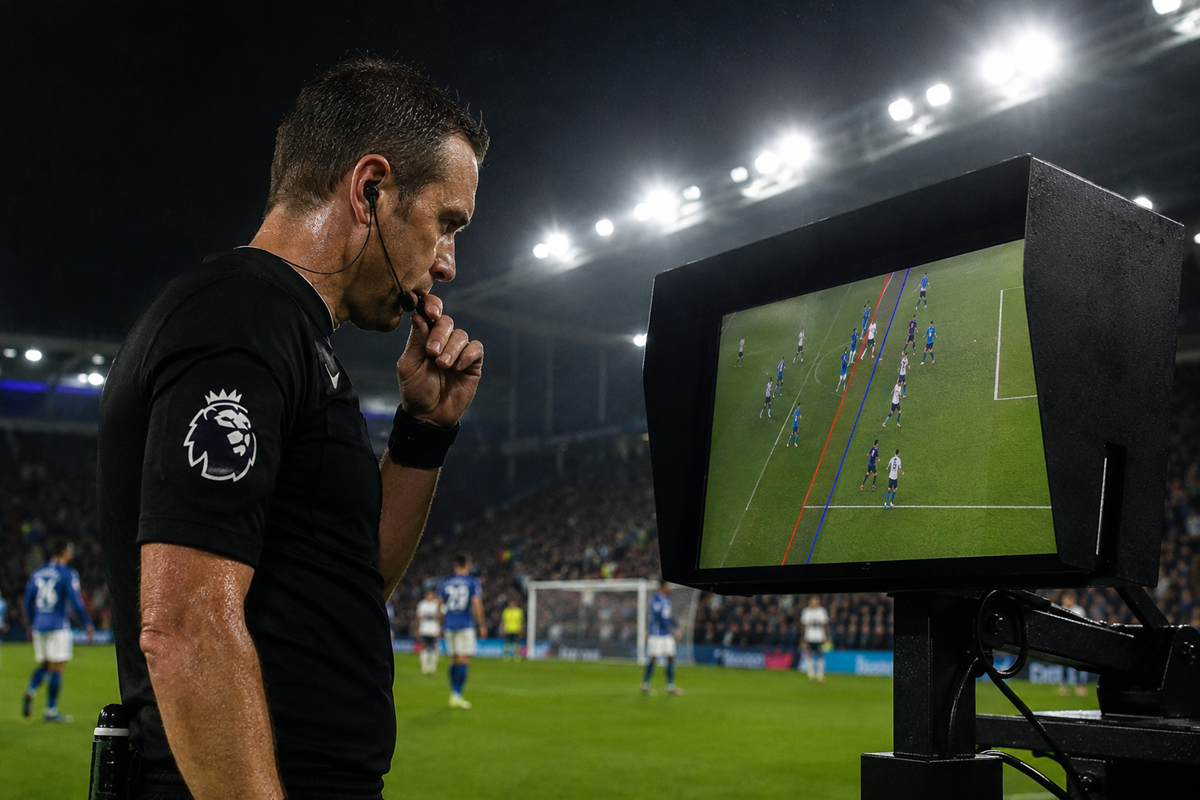
After an agonising review that reportedly lasted nearly four minutes and included 17 separate replay checks, referee Chris Kavanagh was sent to the monitor and overturned the goal after determining that West Ham had fouled Arsenal goalkeeper David Raya during the buildup. The goal was chalked off; Arsenal escaped with all three points, and the title race swung dramatically in their favour. Arsenal F.C. moved five points clear at the top with two games remaining, while West Ham dropped into deeper relegation trouble. That is the issue.
Even if officials believe the decision was technically correct, why does a similar contact go unpunished in other matches? Jarrod Bowen openly questioned the consistency after the game, arguing that similar incidents throughout the season have been ignored. West Ham manager Nuno Espírito Santo also expressed frustration over the lack of clarity surrounding officiating standards. That frustration is shared across the league.
One week, minimal contact with a goalkeeper resulted in a disallowed goal. In another week, defenders may wrestle attackers inside the box during corners without intervention. One week, referees are told to let games flow. The next week, soft fouls are awarded after lengthy video reviews. And that is where the Premier League’s officiating crisis deepens—not necessarily because every decision is wrong, but because nobody seems to know what qualifies as right anymore.
The inconsistency becomes even harder to defend when similar incidents produce completely different outcomes. In Manchester United F.C.’s dramatic clash with AFC Bournemouth, the Red Devils were leading 2-1 late in the second half when Amad Diallo appeared to be blatantly clattered inside the penalty area by a Bournemouth defender after beating his man.
Despite clear contact, the referee waved play on, and VAR chose not to intervene, leaving United players furious. Moments later, in a cruel twist of irony, Bournemouth surged forward, and Harry Maguire was judged to have committed a similar challenge inside his own box. This time, the referee had no hesitation—a penalty was awarded, and Maguire was sent off, reducing Manchester United to ten men in a match they were controlling.
The contradiction was impossible to ignore. It echoed another controversial moment from the opening weekend when Altay Bayındır was clearly impeded by William Saliba during Arsenal F.C.’s opening-day clash with Manchester United, yet Arsenal’s goal was allowed to stand despite what many viewed as obvious goalkeeper interference. These incidents fuel the growing belief that refereeing decisions in England are not being applied evenly, leaving fans wondering whether the issue is poor judgment, inconsistent with VAR interpretation, or a system that simply lacks accountability.
Look Across Europe, and The Contrast Becomes Glaring.
In the UEFA Champions League, referees are often praised for their communication and control of matches. Officials in UEFA competitions have generally shown greater consistency in applying VAR protocols. Referees are quicker with reviews, more decisive in their rulings, and often avoid re-refereeing incidents unless there is an obvious mistake.
Former FIFA referee Karl Tyrrell recently weighed in on the growing controversy surrounding Premier League officiating, insisting that “there are levels to refereeing football matches, just like there are levels to playing the game.” Tyrell argued that while officiating in England remains under immense pressure, the standard has visibly declined compared to major UEFA and FIFA competitions, where officials are often more decisive, consistent, and better positioned to manage high-pressure moments.
He stressed that VAR should be a tool to correct obvious mistakes—not create fresh controversy—and called for improved referee training, stronger accountability, and clearer communication with fans. According to Tyrell, raising the standard “across the board” is now essential if English football wants to restore trust in its officials and prevent referees from overshadowing the sport itself.
At FIFA tournaments such as the FIFA World Cup, fans may disagree with calls, but the system often feels more streamlined. In England? Chaos. This is not the first time English referees have come under scrutiny.
Professional Game Match Officials Limited (PGMOL) has repeatedly apologised for high-profile mistakes over the past few seasons. From wrongly disallowed goals to missed offsides and bizarre handball interpretations, errors continue to pile up despite the availability of technology.
The infamous Liverpool F.C. versus Tottenham Hotspur F.C. VAR offside blunder in 2023 remains one of the biggest examples, when Luis Diaz’s legitimate goal was incorrectly ruled out because of a communication breakdown between VAR officials and on-field referees.
How does that happen in the richest league in the world? The Premier League generates billions of dollars in television revenue. Clubs spend hundreds of millions on players. Yet refereeing standards continue to lag behind the quality of the product. That raises an uncomfortable question: Is this incompetence? Or are English referees simply operating at a lower standard compared to their European counterparts?
The truth may lie somewhere in the middle. Premier League referees face enormous scrutiny because of the league’s global popularity. Every decision is replayed from dozens of angles within seconds. Social media magnifies every mistake. But that cannot be an excuse forever. The best referees should improve alongside the sport.
Instead, VAR has often become a shield for poor officiating rather than a solution. Officials delay decisions, overanalyse incidents, and create unnecessary drama. Football was built on emotion—last-minute winners, dramatic equalisers, and spontaneous celebration. West Ham fans experienced that joy for only a few seconds before technology ripped it away. Whether the decision was correct or not is almost secondary now. The bigger issue is trust.
Right now, fans do not trust referees. Managers do not trust referees. Players do not trust referees. And when trust disappears, the competition’s credibility begins to suffer. Arsenal F.C. may go on to win the Premier League title. West Ham United may be relegated.
And when both clubs reflect on their seasons, they may point to one moment at the London Stadium where a referee’s screen review changed everything. That should terrify the Premier League. Because football matches should be decided by players—not by officials searching for reasons to become the story.