
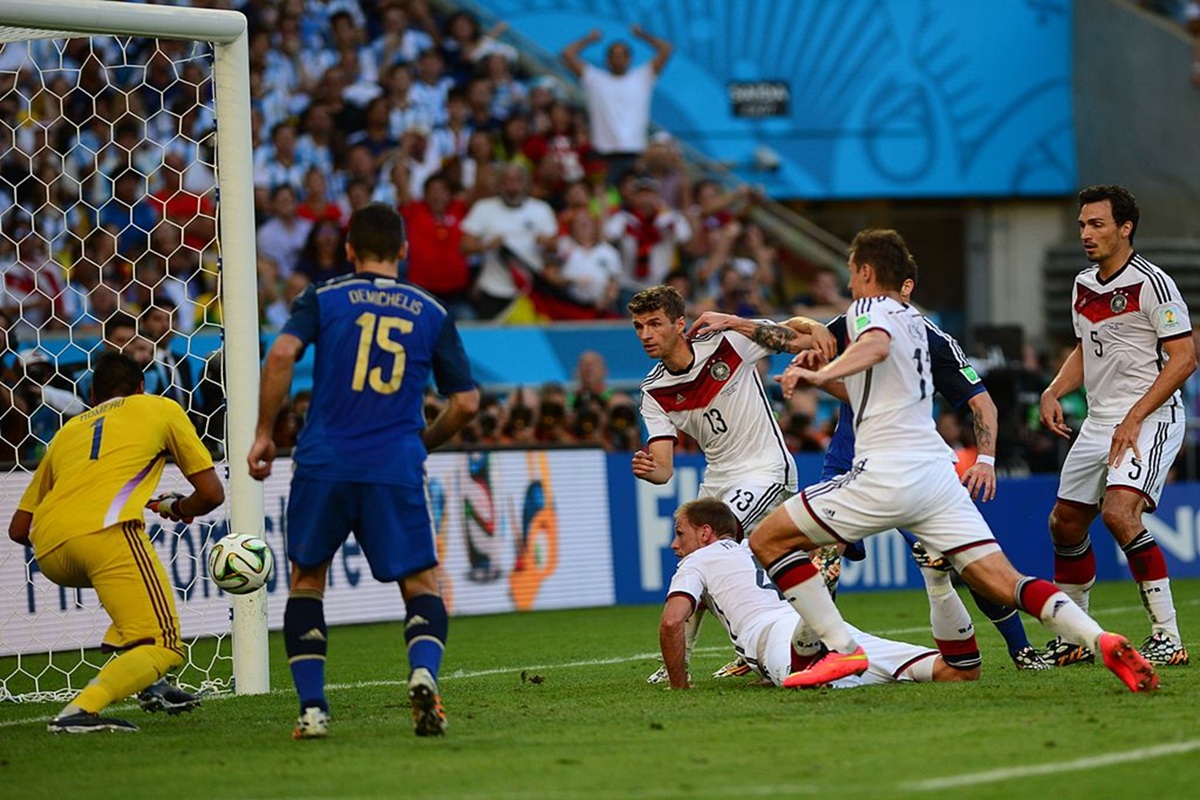
The 2014 Germany World Cup squad did more than win a trophy. It set a new standard for modern international football. In Brazil, this team mixed discipline, flair and cold efficiency.
As a result, Germany became world champions for the fourth time after beating Argentina 1–0 in the final in Rio de Janeiro. Mario Götze scored the winning goal in extra time and sealed a historic night at the Maracanã.
Since the tournament was held in Brazil, both the host nation and the visiting teams felt considerable pressure. But Germany came well-prepared, with a clear strategy and a strong, united team. Their 2014 World Cup squad comprised top players from Bayern Munich and Borussia Dortmund, along with experienced leaders and ambitious young talent.
Germany’s Road To Brazil
Germany had come close many times before. In 2006, 2010 and Euro 2012, they reached semi-finals but fell short. Yet those near misses built experience. They also allowed coach Joachim Löw to refine his high-pressing, possession-based style.
By 2014, the team had become thoroughly familiar with the system. Many players had spent years together at club level. Because of that, the 2014 Germany World Cup squad played with natural understanding. They could control games, press as a unit and break at speed.
2014 Germany World Cup Squad: The Squad At A Glance
FIFA rules meant every team had to name a 23-man squad. Germany’s list combined world-class stars and reliable role players:
Goalkeepers
Manuel Neuer (Bayern Munich)
Roman Weidenfeller (Borussia Dortmund)
Ron-Robert Zieler (Hannover 96)
Defenders
Philipp Lahm, Jérôme Boateng, Mats Hummels, Benedikt Höwedes, Per Mertesacker, Shkodran Mustafi, Erik Durm.
Midfielders
Bastian Schweinsteiger, Sami Khedira, Toni Kroos, Mesut Özil, Thomas Müller, Mario Götze, André Schürrle, Christoph Kramer, Julian Draxler.
Forwards
Miroslav Klose, Lukas Podolski, and Mario Gómez (injured before the tournament and not in the final squad), with Müller and Götze often acting as flexible attackers rather than classic strikers.
Different sources list positions slightly differently, but the core group above made up the 2014 Germany World Cup squad that travelled to Brazil and lifted the trophy.
2014 Germany World Cup Squad: Key Leaders In The Dressing Room
First, Philipp Lahm captained the side. Calm, smart and tactically flexible, he could play at right-back or as a deep midfielder. Due to his intelligence on the ball, he often stepped into midfield to help Germany maintain possession.
Second, Bastian Schweinsteiger gave the team heart and edge. He played with visible emotion, especially in the final, where he battled through heavy challenges and even a cut face. His presence in the 2014 Germany World Cup squad symbolised the grit behind the technique.
Third, Manuel Neuer redefined goalkeeping. He swept behind the defensive line, claimed crosses and started attacks with brave passing. Many fans remember his performance against Algeria, when he played almost like an extra defender.
Finally, Miroslav Klose added history. During the tournament, he became the all-time top scorer in World Cup history with his 16th goal, moving past Brazil legend Ronaldo. That record underlined the experience and quality inside this squad.
👉 Related: The Emotional Journey of the Spain 2010 World Cup Squad
Tactical Identity Of The 2014 Germany World Cup Squad
Joachim Löw built a side that used the ball with patience, yet attacked with speed when space opened. Germany usually lined up in a 4-3-3 or 4-2-3-1 shape. However, the system stayed flexible. Lahm could move into midfield. Müller could drift wide or play as a central forward. Kroos and Özil could drop deeper or push between the lines.
Because the 2014 Germany World Cup squad trusted the ball, they often pushed their defensive line high. Boateng and Hummels stepped into midfield. Meanwhile, full-backs or tucked-in defenders like Höwedes protected the flanks.
In attack, Germany used several patterns:
Overloaded central areas with Kroos, Khedira and Schweinsteiger, then switched play quickly.
Utilised Thomas Müller’s intelligent runs to create openings for others.
Allowed wide players like Schürrle and Götze to cut inside and shoot or combine.
Most of all, this team mixed control and ruthlessness. Once an opponent cracked, Germany rarely showed mercy.
The 7–1 Against Brazil: A Statement Of Power

Source: Deposit Photos
Nothing sums up the 2014 Germany World Cup squad better than the 7–1 semi-final against Brazil. Before the game, many expected a tight match. Instead, Germany scored five goals in the first 29 minutes and stunned the world.
Because Kroos, Khedira and Müller linked so well, Brazil could not cope with the movement. Germany’s pressing forced mistakes. Their finishing felt cold and clinical. That night in Belo Horizonte, the squad showed the full strength of its tactical plan and mental focus.
The Final Against Argentina
However, the final told a different story. Argentina defended well and created big chances on the counter. For long spells, the game stayed tense and tight. Still, the 2014 Germany World Cup squad did not panic.
Löw used his bench with care. He brought on André Schürrle and Mario Götze to add energy. In extra time, Schürrle sprinted down the left and crossed. Götze controlled the ball on his chest and volleyed past Sergio Romero. Germany won 1–0 and became world champions.
That single moment turned the 2014 Germany World Cup squad into legends. It also gave Germany its first World Cup title as a unified nation.
👉 Related: The Beautiful Game Perfected: Brazil’s Magical 1970 World Cup Journey
How Club Football Shaped The Squad
Because so many players came from Bayern Munich and Borussia Dortmund, the squad already understood pressing triggers, passing patterns and intense training standards. Lahm, Neuer, Boateng, Müller, Kroos and Schweinsteiger all played for Bayern. Hummels and Reus (injured before the tournament) led Dortmund’s rise.
This core meant that, even under pressure, the 2014 Germany World Cup squad maintained its structure. Their pressing felt coordinated. Their passing combinations looked automatic. Other nations tried to copy this model by building around successful club teams.
Behind The Numbers
The team was more than just tactics and numbers – it was full of personal stories. Schweinsteiger had faced disappointment in past tournaments, but he kept pushing the team forward. Klose, near the end of his international career, was chasing one last moment of glory. Lahm, known for being quiet and humble, lifted the trophy as captain and soon retired from international football.
Younger players like Götze and Draxler achieved the biggest success early in their careers. Toni Kroos, still in his mid-twenties, used the World Cup to launch his move to Real Madrid. With both older and younger players, the 2014 Germany squad felt experienced yet fresh.
For fans, the team was easy to relate to. Many players spoke honestly about feeling nervous and under pressure, but they also stayed calm and focused. That human side made supporters feel closer to the team, beyond the famous 7–1 victory.
Impact On Modern Football
The 2014 Germany World Cup squad influenced the way national teams think about preparation. They demonstrated that long-term planning, youth development, and a clear tactical identity can outperform pure individual talent.
Germany’s success came after years of investment in academies and coaching. Many members of the squad had already played together in youth tournaments. As a result, they treated the World Cup like the next step in a long shared journey.
Other national teams studied this model. Some tried to copy the focus on data, fitness and flexible roles. The idea of a “complete goalkeeper” like Neuer, who can sweep behind the defence, also spread across world football.
For readers who want more detail on how the 2014 Germany World Cup squad won the final, FIFA’s official tenth anniversary feature offers an excellent overview of the match and the key figures. FIFA
If you want to dig into individual player statistics, minutes played, and tournament contributions, the ESPN World Cup squad page provides a useful breakdown of appearances, goals and assists. ESPN.com
Conclusion: Why The 2014 Germany World Cup Squad Still Matters
Today, many still see the 2014 Germany World Cup squad as one of the best international teams in modern football. The players showed great skill, strong tactics, and mental strength. They famously beat Brazil 7–1 and then won a tough final against Argentina.
The team had grown together over many years and came from a strong football system in Germany. Because of this, they became a model for future national teams. Coaches, analysts, and fans still study how they played, pressed, and used flexible roles
👉 Related: The Untold Story of the Netherlands’ 1974 World Cup Run