
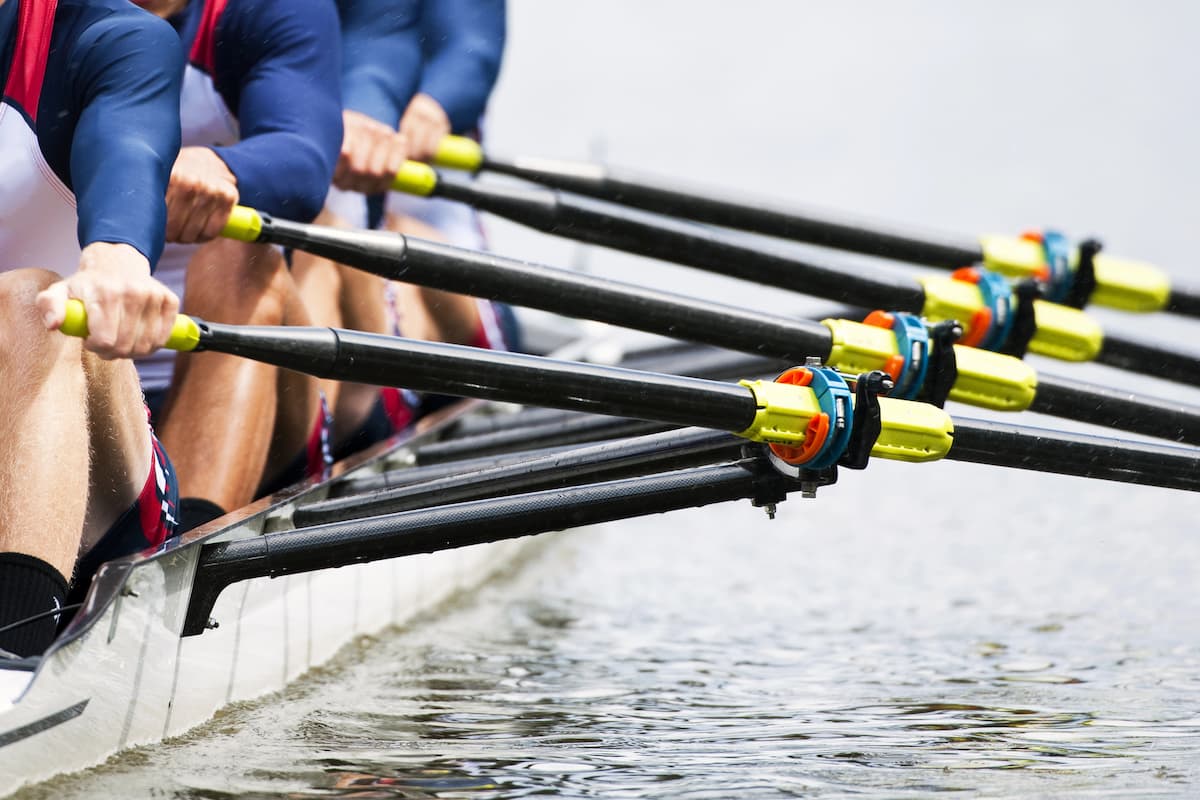
The Men’s University Boat Race, one of the world’s oldest and most famous amateur sporting events, gets under starters oar-ders at 15:46 in London this Saturday. Students from Oxford and Cambridge will go stroke for stroke on the River Thames for the 169th occasion.
The Light Blues from Cambridge have won 86 times, the Dark Blues from Oxford 81 times. Don’t fret, your maths isn’t off, there was also the infamous ‘dead-heat’ race of 1877. You must go right back to 1928 for the last time Oxford held the overall lead and Cambridge have consolidated their advantage in recent years, winning four of the last five editions.
The Boat Race – How It All Began
Nowadays the Oxford and Cambridge Thames tussles are watched by crowds of 250,000 lining the riverbank and more than 100 million via TV worldwide. The event has certainly come a long way since a schoolboy squabble that first got the wheels (oars) in motion. In 1829, two former Harrow School chums, Charles Merivale (now a Cambridge student) and Charles Wordsworth (who was now at Oxford) proposed a rowing race between their two universities.
On the 10th of February 1829, a letter was sent from Cambridge to Oxford. It stated the following, “the University of Cambridge hereby challenge the University of Oxford to row a match at or near London, each in an eight-oared boat during the ensuing Easter vacation.” The gauntlet had been thrown down and the challenge was duly accepted. The race took place on the 10th June of the same year in Henley-on-Thames, on a 3.6km stretch of the River Thames between Hambleden Lock and Henley Bridge. It was officially recorded that Oxford won the race “easily”. One tradition that was established in the 1829 race and which would remain in place throughout, was that Oxford would continue to row in the dark blue colours of Wordsworth’s Christ Church College.
The Boat Race Moves To London
Cambridge would level the scores when a second race occurred in London, some 7 years later in 1836. They cruised to a 20 lengths victory over a longer 9.3 km course between Westminster Bridge and Putney Bridge. All encounters from 1845 onwards, apart from the odd exception, would be raced over the current ‘Championship Course’. A 6.8 km route of the Thames in London between Putney and Mortlake, which is also referred to as the Tideway. The race starts downstream of Putney Bridge, passes under Hammersmith Bridge and Barnes Bridge, before finishing just before Chiswick Bridge.
A coin toss determines the side on which the teams will race. The two possibilities are either the Middlesex side of the river or the Surrey side. Each side has its pros and cons which are related to the way the river bends. The Cambridge and Oxford clubs’ presidents toss an 1829 gold sovereign coin (to commemorate the origins of the race) for the right to choose which side of the river they row on.
Memorable Boat Race Moments
They still talk about the 1877 race all these years on, especially in the Oxford ranks. The race was staged in shocking weather conditions and event judge John Phelps deemed it a dead heat. Many thought he had made a mistake, the Dark Blues in particular, as they thought they had won. Witnesses on the day seemed to back up the Oxford claims. However, Phelps remained adamant that both boats had nosed across the finish at exactly the same time. Sympathies have swayed in Phelps’ favour over time, as he had by far the best vantage point compared with the massed spectators. One positive that came out of the furore was that finishing posts were introduced for the first time, the following year, to help prevent any further disputes.
The 1859 renewal would mark the first occasion when one of the boats would sink during the race. Cambridge had requested a postponement prior to the start due to extremely rough conditions, but their pleas failed to register. Unsurprisingly, it would be the Cambridge crew who would suffer the boat mishap and Oxford rowed to victory while the Light Blues either swam to shore or were rescued in the water. In 1912 both boats would suffer problems, with Cambridge sinking and Oxford waterlogged and unusable. A re-row was ordered for two days later, which Oxford won easily by 6 lengths. There would be another three occurrences of mid-race sinkings. Oxford in 1925 and again in 1951 and the last occasion being Cambridge in 1978.
Interruptions In Boat Race Proceedings
The First World War meant that the race was stopped for five years (1915-1919) and there would be another hiatus, a longer one of six years (1940-1945), while the Second World War raged on. The 2012 edition had to be halted mid-race, as a protestor deliberately swam into the River Thames between the two boats. The race was stopped on safety grounds, but was later restarted, with Cambridge claiming a cosy victory after Oxford suffered oar issues.
The Covid outbreak caused the 2020 race to be cancelled. The following year (2021), with some Covid restrictions still in place and repairs to Hammersmith Bridge required, it was decided that the race would take place away from London. The crews did battle on a 5km stretch of the River Great Ouse, near Ely. It was first time since the inaugural edition of the race in 1829 that the event had taken place away from the capital.
All The Boat Race Facts & Figures
The fastest ever time recorded over the ‘Championship Course’ was 16 minutes 19 seconds set by Cambridge in 1998. With three winning crews recording times under the 17th minute mark in the past six renewals, it could be a record that goes sooner rather than later. At the opposite end, the slowest ever winning time, was recorded at 26 minutes and 5 seconds (by Cambridge in 1860). Nearly 10 minutes adrift of the Cambridge 1998 speedsters.
The biggest winning margin over the Championship Course was registered by the Light Blues crew of 1900. Pre-race commentators had suggested the Cambridge boys were one of the best they’d ever been and so it proved, as they stormed to an epic 20 lengths victory. The most nail-biting finish we’ve had, aside from the ‘dead-heat’ debacle, occurred in the 2003 race. Oxford would back up their ¾ length win in 2002 with a nerve jangling 30cms success. If recent years are anything to go by, we should be in for a close battle this Saturday, as all the previous seven races have been won by 3 lengths or less.
Cambridge Look To Extend Their Advantage
It was Oxford who would grab the initiative during the early years of the annual Varsity Thames Tussle. Following their second streak of nine wins in 1898, the Dark Blues held a 32-22 series advantage. The power shifted dramatically in Cambridge’s favour between the World Wars and after racking up a record-breaking 13-win run in 1936, the Light Blues were 47-40 up. Oxford came within one win of equalling the head-to-head stats (68-69) in 1992, when claiming a 16th victory in the space of 17 years. However, Cambridge got their act together and have pushed away again in recent times, with 4 wins in the past 5 editions to claim a 86-81 lead.
Famous ‘Boat Races’ At the Boat Race
Unsurprisingly, the 4-time Olympic gold-medallist, Sir Matthew Pinsent, was a dual winner for Oxford in the 1990 & 1991 Boat Races. The former St Catherine’s College graduate and hero returns this year as the Men’s Race umpire. The popular British historian and television presenter, Dan Snow, also competed for Oxford in three Boat Races. He was on the losing side in 1999 & 2001, but did have a cox-throwing celebratory moment in 2000.
More surprisingly, Hugh Laurie, British actor and comedy legend, rowed for Cambridge in the 1980 race. His father also rowed for the Light Blues during the Cambridge dominant years of the 1930s. Unfortunately for Hugh, Oxford would clinch victory in 1980 renewal. However, Rowing’s loss would be showbusiness’ gain.
In 2019, Matthew Pinsent’s Coxless Four Olympic co-star, James Cracknell became the oldest Boat Race crew member ever, when rowing for Cambridge, at 46-years of age. Success breeds success, and Cracknell like Pinsent, would also celebrate a Boat Race win.
The Rise Of The Women
The first ever Women’s University Boat Race took place in 1927, on The Isis in Oxford. It was a race/competition, but not a side-by-side encounter as we’ve come accustomed to. The crews raced separately, as they were not allowed on the water at the same time as each other. The teams would row downstream, where they were judged on style and then they would row back upstream to record a time. Oxford claimed victory in that first ever contest.
The first side-by-side women’s clash took place in 1936 at The Isis once again. The location of the race alternated between The Isis and the River Cam over the years that followed and was raced over a distance of approximately 1000 yards. Sadly in the 1950’s both Oxford and Cambridge Women’s University Boat Clubs suffered from financial problems and as a result no women’s boat race took place for over a decade (1953-1963).
The women returned to the water in 1964 and have raced annually ever since. From 1977 onwards, the race was shifted to Henley-on-Thames permanently. Both University communities responded positively to the move and the race was always well supported. In 1981, Oxford made history by selecting the first female cox in the men’s race, Sue Brown. She would help guide the Dark Blues to back-to-back Boat Race triumphs.
The Women Finally Arrive in London
2015 would prove a pivotal year for the Women’s Boat Race, which was celebrating it’s 70th anniversary. For the first time ever, the women’s crews raced on the same Championship Course as the Men’s Boat Race. They also raced on the same day, which has occurred every year since. Cambridge have an overall lead in the women’s race standings, as they do in the men’s version. Though with a 47-30 advantage, the Light Blues ladies are even more of a dominant force. They will go for a 7th straight victory on the Thames this Saturday.
The Boat Race 2024 – Saturday’s Schedule
14:46 – 78th Women’s Race
15:01 – Women’s Reserve Race (Osiris v Blondie)
15:16 – Men’s Reserve Race (Isis v Goldie)
15:46 – 169th Men’s Race
BBC One are screening live coverage from 14:00 on Saturday
Super League – The Egg-Chasing Easter Extravaganza
Donny Lalonde: The Canadian Champion
Tim Tszyu vs Sebastian Fundora Preview: All or Nothing at 154lbs
Should Babar Azam be Captain Again for Pakistan?
Indian Premier League – The Overseas Heroes
March Madness – Switch Those Brains On, It’s Bracketology Time
Image Credit: Deposit Photos