
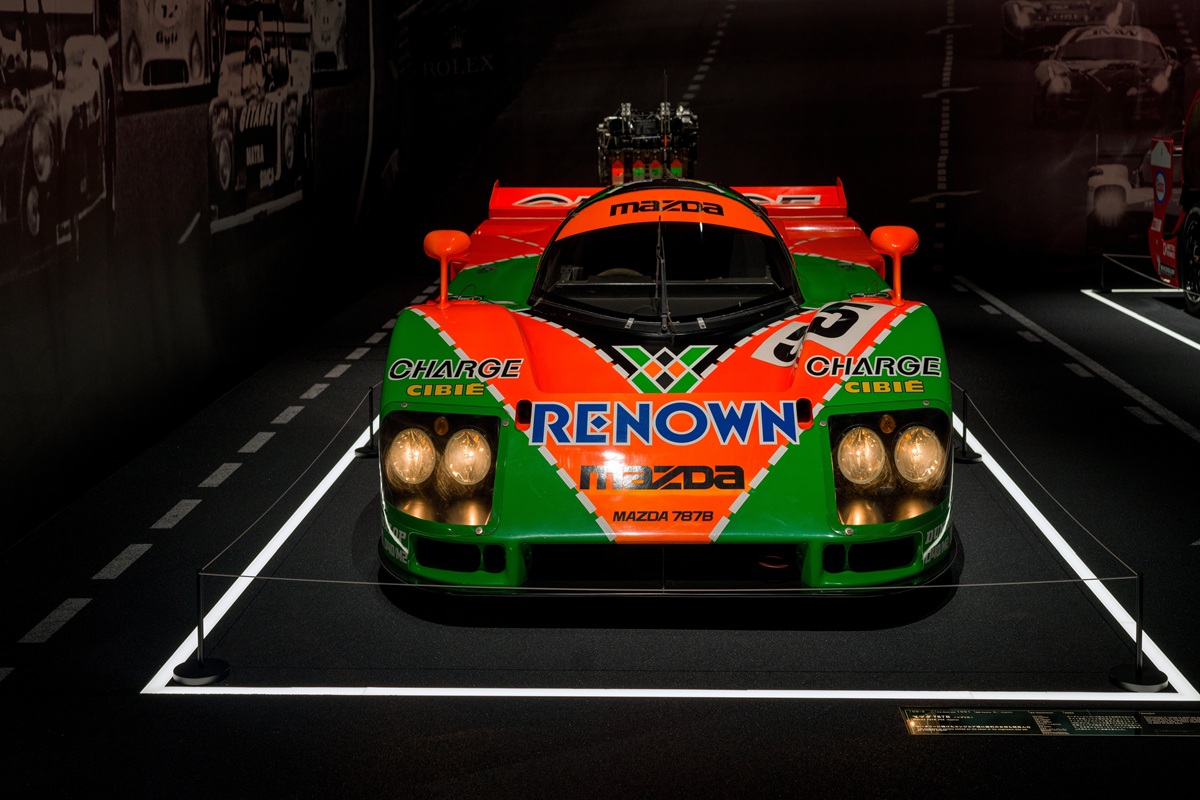
The Mazda 787B was the first Japanese car to win the 24 Hours of Le Mans. Although the race was uneventful, the banshee-like scream from the rotary engines and fans marks this race as iconic.
The idea that the 787B led to the ban on rotary engines at Le Mans emphasises its legendary status. However, the rules changed the following year, banning rotary engines (along with many others) starting in 1992 and making Formula One engines the new standard.
Back In Time
In 1991, Mazda decided to do things its own way. Aware that the rotary engines would be banned the following year, they took a chance on the 787B. Aonce-in-a-lifetime victory, and it was Mazda’s last chance to prove itself to the big boys.
After a disappointing 1990 debut for the 787, Mazda’s chief and engineers decided it was time to develop a list of improvements for the 787B. Reliability, circuit suitability, acceleration, and cornering speed were among these improvements. One last ask from Mazda’s chief of product development, an extra 100bhp over the 630bhp in the 787.
The engineers not only achieved this but also completely overhauled the engine, implementing more than 80 improvements. Foot to the floor, anywhere from 6,000rpm to the 9,000rpm redline meant at least 95 per cent of peak torque. In real terms, the 787B could stay at full shove around the entire circuit.
The 787B was also the first car to win Le Mans with carbon brakes and represents a hugely significant victory for Japanese and Asian motorsport as a whole.
The Iconic 55
The sound, appearance, and engineering reflect some of the purest forms of design. The engine’s roar sends chills down the spine when it has its chance to unleash power. You can check it out in all its glory here. On the 23rd of June 1991, Mazda became thefirst Japanese manufacturer to win the world’s most famous endurance race.
Covering 362 laps during the 1991 24 Hours of Le Mans. Over the course of its 28 pit stops, the winning Mazda had received just one oil top-up, a change of brake discs and pads, plus one nose change. Aside from that, the 700bhp four-rotor R26B-powered 787B required only fuel and tyres as it effortlessly proved the reliability, efficiency and performance of Mazda’s unique rotary engine technology.
After winning Le Mans, the team retired the number 55 Mazda 787B from competition. Now, chassis 002 proudly sits in the Mazda HQ museum in Hiroshima.