
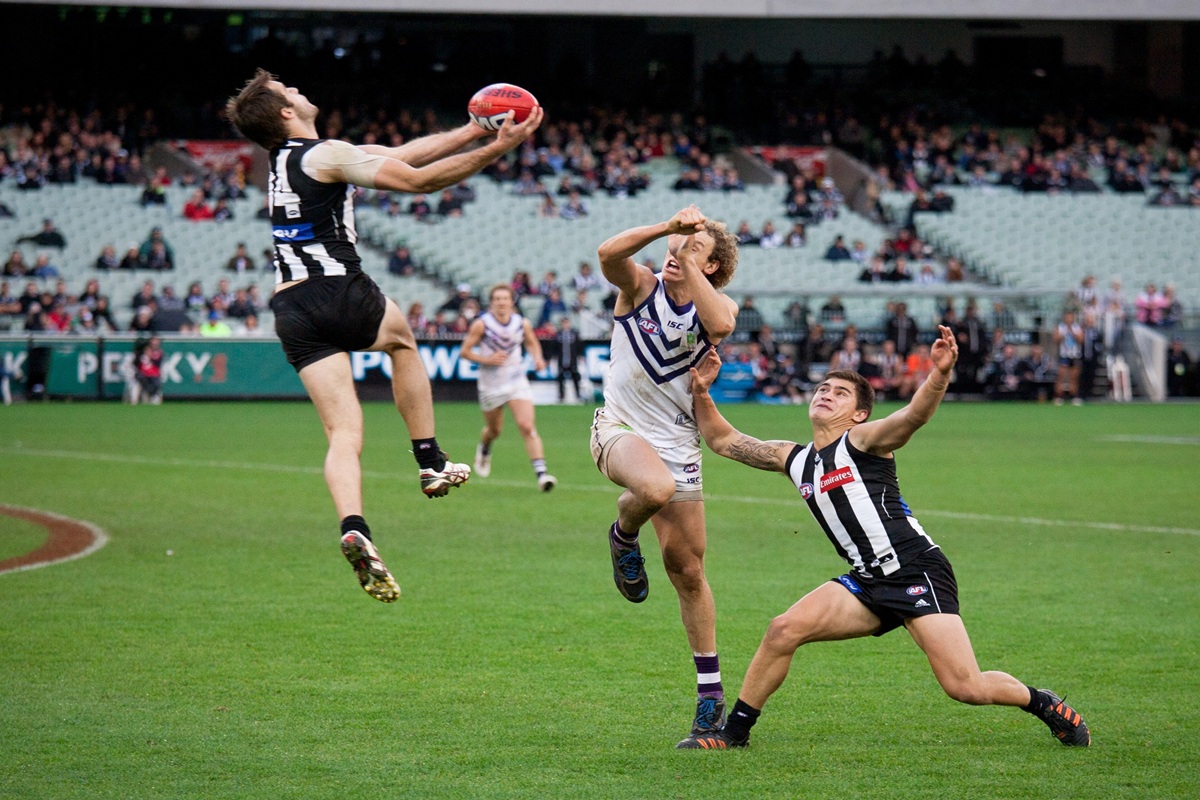
Australian rules football can look chaotic when you first watch it. The ball moves fast. Players can kick, handball, mark, tackle, run, spoil and crash packs. The ground is huge, the score has two numbers, and the umpire’s whistle can seem hard to follow.
Yet once you understand the basics, AFL becomes far easier to enjoy. At its heart, the game is simple. Two teams try to move an oval ball down the field and score through the posts. A goal is worth six points. A behind is worth one point. The team with the highest total score wins.
This guide explains the core AFL rules in plain English. It is designed for new fans, UK readers, casual viewers and anyone who wants a quick way into Aussie Rules without getting buried in every technical detail.
For simpler explainers across sports, start with our World In Sport sports guides. For match reports, season coverage and weekly stories, visit our AFL news and analysis.
You can also read our AFL 2026 Season Preview for wider context on the current campaign and Cook Kicks Winner as Showdown 59 Delivers AFL 2026, Thriller
Embed from Getty Images
What is AFL?
AFL is the top professional Australian rules football competition. The sport is played on a large oval field, usually a cricket ground, with two teams trying to score at opposite ends.
Each end has four posts. The two tall middle posts are the goal posts. The shorter outer posts are the behind posts. Kicking the ball cleanly through the middle posts scores a goal. Sending it through the outer area, or having it touched before crossing the goal line, usually scores a behind.
The official AFL laws say Australian Football should protect the player who makes winning the ball their main aim, keep the game free-flowing, and balance attack with defence. The laws also emphasise player safety, which is important because AFL is a body-contact sport.
AFL rules at a glance
| Rule area | Simple explanation | Why it matters |
|---|---|---|
| Scoring | A goal is worth six points. A behind is worth one point. | The scoreline can look unusual until you know how both parts work. |
| Players | AFL teams usually have 18 players on the field, plus interchange players. | The ground is large, so players cover a lot of space. |
| Match length | A standard match has four quarters of 20 minutes of playing time. | Quarters run longer in real time because the clock stops. |
| Mark | A player earns a mark by catching a kick that travels at least 15 metres. | A mark gives that player time and space to kick. |
| Tackle | Players can tackle an opponent who has the ball. | Good tackling creates turnovers and free kicks. |
| Handball | The ball can be punched from one hand with the other fist. | It keeps play moving when kicking is not possible. |
How scoring works in AFL
AFL scoring is one of the first things new fans notice.
A goal is worth six points. It is scored when an attacking player kicks the ball through the two tall middle posts without another player touching it. A behind is worth one point and can happen when the ball goes through the outer posts, hits a post, is touched before crossing the goal line, or is carried over by a defender.
That is why AFL scores are written in three parts. For example:
10.8 (68)
This means the team has kicked 10 goals and 8 behinds. The total score is 68 points because 10 goals equal 60 points, plus 8 behinds.
So, if you see:
Collingwood 12.10 (82) defeated Carlton 11.9 (75)
It means Collingwood kicked 12 goals and 10 behinds for 82 points. Carlton kicked 11 goals and 9 behinds for 75 points. Collingwood won by seven points.
How long does an AFL match last?
A standard AFL match is played over four quarters. Each quarter is 20 minutes of playing time. However, the real time is longer because the clock stops for goals, injuries, boundary throw-ins, umpire stoppages and other breaks in play. The official laws describe a match as 80 minutes, split into four 20-minute quarters, excluding stoppages.
That is why an AFL match can last around two hours or more from start to finish.
There are short breaks at quarter-time and three-quarter-time, plus a longer half-time break. The rhythm is different from that of football, rugby, or American football. AFL has constant movement, but the quarter breaks give teams a chance to reset tactics and change momentum.
How many players are on an AFL team?
At the AFL level, a team usually has 18 players on the field. The laws state that a team must consist of between 14 and 18 players on the playing surface, with no more than four interchange players, unless a controlling body sets a different number.
The 18 on-field players are spread across defence, midfield and attack. However, AFL is not as fixed as some other sports. Players move constantly. Defenders can attack. Forwards can press. Midfielders can run from end to end.
A simple way to view the team shape is:
- Defenders stop scores and start attacks
- Midfielders win the ball and move it forward
- Forwards create scoring chances
- Rucks contest aerial taps at stoppages
Modern AFL is very fluid. Positions matter, but work rate, spacing and pressure often matter just as much.
What is a mark in AFL?
A mark is one of the most important AFL rules.
A player takes a mark when they catch the ball from a kick that has travelled at least 15 metres, without the ball touching the ground or another player first. Once the mark is paid, that player gets a free kick from that spot.
This is why you often see players leap into packs to take big catches. A strong mark can stop the game, calm pressure and set up a shot at goal.
There are different types of marks:
A chest mark is taken safely against the body.
An overhead mark is taken above the head.
A contested mark is taken under pressure from opponents.
A speccy is a spectacular high mark, often taken by jumping on or over another player.
For new fans, the key point is simple. If a player catches a clean kick over 15 metres, they usually control the next moment of the game.
How do players move the ball?
Players can move the ball in several ways.
They can kick it. They can handball it. They can run with it, but only if they bounce it or touch it to the ground after a set distance. They cannot throw the ball.
Kicking is the main attacking tool. A long kick can gain territory, find a teammate or create a scoring chance. A short kick can control possession. A high kick into the forward line can invite a marking contest.
A handball is not a throw. The player holds the ball in one hand and punches it with the other. Handballs are useful in tight spaces, especially when players are under pressure.
Running with the ball is exciting, but risky. If a player holds it too long and is tackled, the umpire may penalise them for holding the ball.
Tackles and holding the ball
AFL tackling is physical, but it has limits.
A player can tackle an opponent who has possession. The tackle must not be too high, too low, dangerous or late. The aim is to stop the ball carrier and force a legal disposal.
The holding-the-ball rule is one of the biggest talking points in the AFL. In simple terms, if a player has had a chance to dispose of the ball and is then tackled, they must try to kick or handball it. If they do not, the umpire can award a free kick.
This rule creates drama because the decision often depends on timing. Did the player have a prior opportunity? Was the tackle legal? Did they make a genuine attempt to dispose of the ball? These calls can split fans, especially late in close games.
Free kicks explained
A free kick gives possession to a player after an infringement. The player can go back and kick, handball, or play on.
Common reasons for free kicks include:
- high contact
- holding the man
- push in the back
- holding the ball
- incorrect disposal
- kicking the ball out on the full
- dangerous tackles
- interference after a mark
- running too far without bouncing
AFL is fast, so not every contact is a foul. Players can bump, tackle, spoil and contest the ball. The umpire must decide whether the contact is legal, careless, dangerous or unfair.
That judgment is part of why AFL rules can feel confusing at first. The same incident may look different from another angle.
What does “play on” mean?
“Play on” means the game continues.
The umpire may call play on when a player moves off their line after a mark, takes too long, chooses to run, or when the ball remains live after a contest. The official laws say the football remains in play whenever the field umpire calls and signals “Play On” or “Touched Play On”.
This is a key phrase for new fans. When you hear “play on,” the player no longer has protected time. Opponents can tackle, chase and pressure them.
Boundaries, throw-ins and out on the full
The boundary line runs around the oval.
If the ball crosses the boundary after bouncing or being touched, the boundary umpire usually throws it back into play. This creates a ruck contest near the line.
If a player kicks the ball over the boundary line without it bouncing or being touched, that is usually out on the full. The other team gets a free kick from near where the ball crossed the line.
This rule rewards accurate kicking. It also stops teams from simply blasting the ball out to gain ground without risk.
What happens after a behind?
After a behind is scored, the defending team brings the ball back into play. A player can kick out from the goal square or play on quickly.
This restart is important. A poor kick-in can give the ball straight back to the attacking side. A good kick-in can open the field and start a counter-attack.
The 2026 official laws state that after a behind, a defending player may kick the ball from within the goal square or play on by exiting the goal square within a reasonable time.
What do the umpires do?
AFL uses several types of umpires.
Field umpires control general play. They bounce or throw up the ball, take free kicks, call marks and manage the flow of the game.
Boundary umpires judge when the ball crosses the boundary line. They throw the ball back in when needed.
Goal umpires judge goals and behinds. They use hand signals and flags to confirm the score. Under the laws, a goal umpire signals a goal by raising both index fingers and waving two flags. A behind is signalled with one index finger and one flag.
For new viewers, goal umpires are useful. Their signals help confirm whether a shot was worth six points or one.
Key AFL terms for beginners
AFL has its own language. Here are the terms that help most when watching a match.
Ball-up: The umpire throws the ball into the air to restart play after a stoppage.
Bounce: A centre restart where the umpire bounces the ball, usually at the start of a quarter or after a goal.
Clearance: Winning the ball from a stoppage and moving it away.
Inside 50: An entry into the attacking 50-metre arc.
Ruck: A tall player who contests ball-ups, throw-ins and centre bounces.
Spoil: Knocking the ball away from an opponent trying to mark it.
Smother: Blocking an opponent’s kick just after it leaves the boot.
Set shot: A shot at goal after a mark or free kick.
Pressure: Chasing, tackling and forcing rushed decisions.
The corridor: The central channel through the ground. Teams use it to attack quickly, but mistakes there can be costly.
Why AFL rules feel different from football
If you know football, rugby or NFL, AFL can feel unusual.
Unlike in football, players can use their hands but cannot throw the ball. Unlike rugby, forward kicking is central to the sport. Unlike the NFL, play is more continuous, and players attack and defend in the same phase.
If you want another simple rules guide, read our Football Rules Explained and compare how each sport handles scoring, fouls, restarts and player roles.
AFL’s appeal comes from that mix. It has aerial contests, heavy pressure, endurance running, fast kicking and sudden momentum swings. A team can dominate territory but waste chances. Another team can score quickly from a turnover.
How to watch AFL as a new fan
Do not try to learn every law in one match. Watch the simple patterns first.
Follow the ball. Notice which team wins clearances. Watch how defenders try to intercept kicks. Look at how forwards lead into space. Pay attention to inside 50 entries and set shots.
Then listen for umpire calls. “Mark,” “play on,” “holding the ball”, and “out on the full” explain a lot of what is happening.
You can also follow weekly match stories through our AFL 2026 Opening Round coverage, which shows how rules, pressure and scoring swings shape real games.
For official details, the AFL Laws of the Game page explains the purpose and principles behind the laws, while Play AFL’s Laws of the Game gives another official route into the current rules.
AFL rules FAQ
What are the basic rules of AFL?
The basic AFL rules are simple. Two teams try to score more points than the other by kicking the ball through posts at either end of an oval field. A goal is worth six points. A behind is worth one point. Players can kick, handball, mark, tackle and run with the ball.
How many points is a goal in AFL?
A goal is worth six points. A behind is worth one point.
Why does an AFL score have two numbers?
AFL scores show goals and behinds before the total. For example, 9.12 (66) means nine goals and 12 behinds, for a total of 66 points.
What is a mark in AFL?
A mark is awarded when a player catches a kick that travels at least 15 metres without touching the ground or another player. The player then gets a free kick from that spot.
Can you throw the ball in AFL?
No. Players can kick or handball the ball, but they cannot throw it. A handball must be punched from one hand with the other.
What is holding the ball?
Holding the ball is a free kick paid against a player who is tackled after having a chance to dispose of the ball and does not legally kick or handball it.
How long is an AFL game?
An AFL match has four quarters of 20 minutes each. The real match takes longer because the clock stops for different breaks in play.
Final word
AFL looks complex because it is fast, physical and full of movement. However, the core rules are easy to follow once you know the basics.
Remember the key points. Goals are worth six. Behinds are worth one. A mark gives a player a free kick. Tackles create pressure. Free kicks punish unfair or illegal play. The team that uses the ball best, wins territory and takes its chances usually wins.
Once those ideas click, Aussie Rules becomes one of the most watchable sports in the world.
Great article Adam – well done!