






















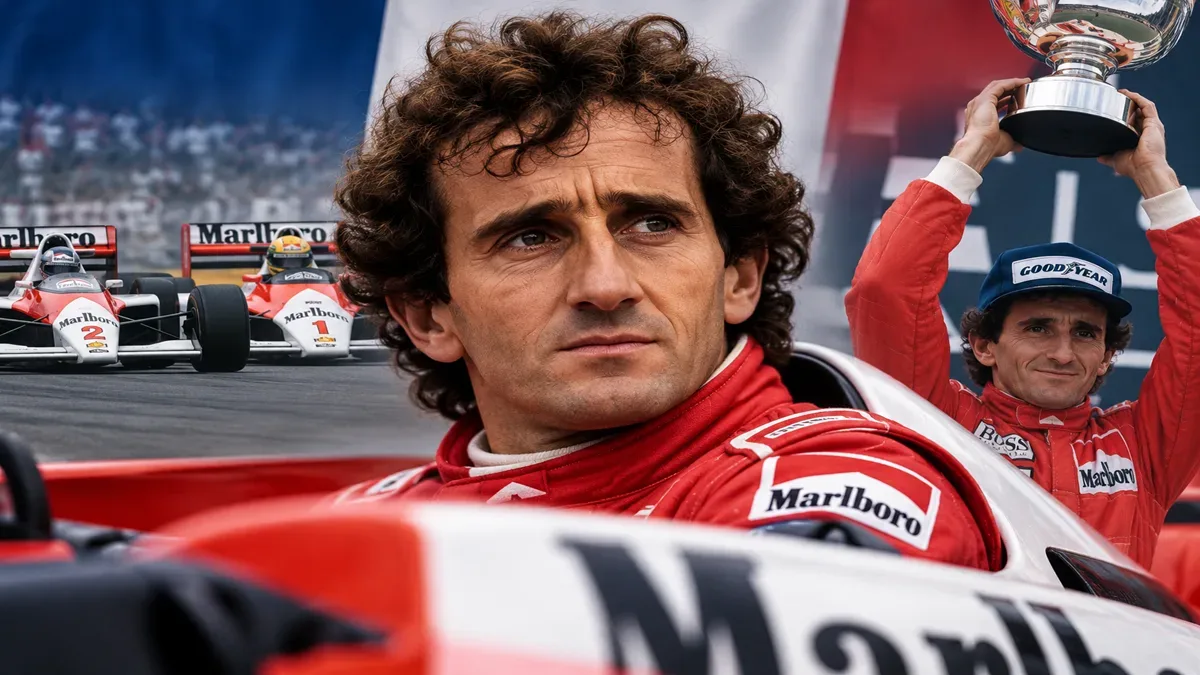
Alain Prost built one of Formula 1’s most successful careers through precision, patience and an exceptional understanding of racing. The French driver won four World Championships, claimed 51 Grand Prix victories and established a reputation for making difficult decisions look remarkably simple.
Known as ‘The Professor’, Prost approached Formula 1 differently from many of his rivals. Rather than chasing outright speed on every lap, he understood how to protect his tyres, manage his machinery and judge when to attack. His approach helped him win championships against some of the strongest drivers in motorsport history.
Yet his career was anything but straightforward.
Prost lost one world title by half a point, survived several bitter team disputes and became the central figure in one of Formula 1’s most contentious rivalries. His battles with Ayrton Senna transformed McLaren’s internal competition into a contest that captivated the wider sporting world.
Between his debut in 1980 and retirement in 1993, Prost raced for McLaren, Renault, Ferrari and Williams. He became France’s first Formula 1 World Champion and, for a time, held the record for the most Grand Prix victories.
His achievements place him among the greatest Formula 1 drivers of all time. However, understanding his career requires more than counting championships. Prost’s defining quality was his ability to balance speed, risk and consistency across an entire season.
That intelligence helped him turn narrow defeats into lasting success.
Early life and the discovery of karting
Embed from Getty ImagesAlain Marie Pascal Prost was born on 24 February 1955 in the Loire region of France, near Saint-Chamond. His father, André, worked in furniture manufacturing, while Prost grew up with interests that extended beyond motor racing.
As a child, he enjoyed football, wrestling and roller skating. He considered a future in sport, although driving racing cars was not initially his ambition.
That changed when he discovered karting at the age of 14 during a family holiday in southern France.
Karting offered an immediate attraction. The small machines rewarded precise steering, quick reactions and an understanding of how to maintain speed through corners.
Prost developed rapidly and began competing seriously.
In 1974, he left school to concentrate on racing. He supported his ambitions by working with kart engines and equipment, gaining practical mechanical knowledge alongside competitive experience.
Winning the French senior karting championship in 1975 opened the door to Formula Renault.
Prost dominated the French Formula Renault championship in 1976 before progressing through higher categories. By 1979, he had won both the French and European Formula Three championships.
His success attracted Formula 1 teams, but Prost approached his next move carefully. He wanted an opportunity to develop rather than simply occupy a seat.
McLaren eventually secured his signature for the 1980 season.
The young Frenchman had reached the highest level of motorsport. However, his first year would reveal how much he still needed to learn.
McLaren debut and the move to Renault
Prost made his Formula 1 debut at the 1980 Argentine Grand Prix, finishing sixth and scoring a championship point.
It was a promising start for a newcomer entering a demanding championship.
However, McLaren were struggling to compete consistently with the leading teams. Prost also suffered accidents and injuries during his rookie campaign, including a broken wrist.
He finished the season with five championship points.
Despite his potential, his relationship with McLaren became strained. Concerns about reliability and the team’s direction encouraged him to seek another opportunity.
Renault offered that chance.
The French manufacturer had introduced turbocharged technology to Formula 1 and wanted to turn its technical progress into race victories.
For Prost, joining Renault in 1981 meant driving for a national manufacturer with growing ambitions.
His breakthrough arrived at the French Grand Prix at Dijon-Prenois.
Prost claimed his first Formula 1 victory after a race interrupted by rain. The result confirmed that he could convert junior-category promise into success against established Grand Prix drivers.
He added victories in the Netherlands and Italy that season.
More importantly, he established himself as a serious contender rather than a promising newcomer.
Renault’s title challenge and the disappointment of 1983
Renault possessed considerable engine power, but outright speed did not always produce consistent results.
Turbocharged engines presented challenges involving reliability, fuel consumption and power delivery. Drivers needed to understand when to push, and when to protect their machinery.
These conditions suited Prost’s analytical approach.
In 1982, he won the opening two races in South Africa and Brazil. However, reliability problems prevented him from maintaining an effective championship challenge.
The following season offered a stronger opportunity.
Prost won four races in 1983 and fought Nelson Piquet for the Drivers’ Championship.
The contest reached the final race in South Africa, where Prost entered with a narrow advantage.
A turbocharger failure forced him to retire. Piquet finished third and secured the title by two points.
For Prost, the defeat exposed the difference between possessing a fast car and sustaining a championship-winning campaign.
Renault had demonstrated its potential, but the relationship between driver and team deteriorated.
Following the championship disappointment, Prost departed Renault.
He returned to McLaren for 1984, beginning the most successful period of his career.
Learning from Niki Lauda at McLaren
Embed from Getty ImagesProst’s return to McLaren placed him alongside three-time World Champion in the making Niki Lauda, who had already won two titles.
Lauda possessed extensive experience and a disciplined approach to racing. He understood how to judge risk, manage equipment and maximise results over a championship season.
Their partnership became an important part of Prost’s development.
Although Prost already had considerable speed, working alongside an experienced champion offered another perspective on winning.
World in Sport’s Niki Lauda career profile explores the Austrian driver’s methodical approach and his influence on Formula 1.
The 1984 championship became an internal McLaren contest.
Prost won seven races, while Lauda claimed five victories. However, Lauda’s consistency helped him remain competitive despite winning fewer Grands Prix.
One decisive moment came at Monaco.
Heavy rain disrupted the race, with Prost leading while Ayrton Senna rapidly closed the gap in a Toleman.
Officials stopped the contest after 31 laps. Prost received the victory, but only half points were awarded because the race had not reached the required distance.
The shortened event became significant when Lauda eventually won the championship by just half a point.
Prost finished with 71.5 points against Lauda’s 72.
It remains the smallest championship-winning margin in Formula 1 history.
Although Prost had won more races, Lauda had secured the title. The result reinforced an important lesson: consistent scoring could matter as much as outright speed.
Becoming France’s first Formula 1 World Champion
Prost entered 1985 determined to convert his speed and experience into a championship.
This time, his performance across the season proved decisive.
He won five Grands Prix, including races in Brazil, Monaco, Great Britain, Austria and Italy.
Rather than relying on victory alone, he combined strong race pace with consistent points finishes.
At Brands Hatch, Prost finished fourth in the European Grand Prix and secured the championship with two races remaining.
He became the first French driver to win the Formula 1 World Drivers’ Championship.
The achievement carried enormous significance for French motorsport.
France had produced successful Grand Prix drivers, including René Arnoux, Jacques Laffite and Patrick Depailler. However, none had previously claimed the Drivers’ Championship.
Prost had now achieved the country’s most important individual honour in Formula 1.
His success also marked a personal transformation.
The driver who had narrowly missed out with Renault and McLaren had learned how to sustain a championship campaign.
He would face an even greater test the following year.
The dramatic 1986 championship battle
The 1986 season remains one of the strongest examples of Prost’s competitive judgement.
Williams possessed a formidable package and fielded Nigel Mansell and Nelson Piquet.
Both drivers presented serious title challenges, while McLaren faced difficulties matching Williams’ overall performance.
Prost nevertheless remained competitive through careful race management and consistent results.
The championship reached its conclusion at the Australian Grand Prix in Adelaide.
Mansell entered the finale leading the standings with 70 points. Prost had 64, while Piquet held 63.
Mansell appeared well placed to claim his first world title.
However, the race changed dramatically when his left-rear tyre failed at high speed, forcing him to retire.
Williams then brought Piquet into the pits because of concerns about tyre safety.
Prost, who had already stopped after suffering a puncture, benefited from his earlier tyre change.
He went on to win the race and claim his second consecutive World Championship.
It was an extraordinary conclusion to a demanding season.
Prost had not possessed the strongest car throughout the campaign. Yet he had remained close enough to take advantage when circumstances changed.
The victory demonstrated that championship success required more than producing the fastest qualifying lap.
Why Alain Prost was called ‘The Professor’
Prost’s nickname reflected his reputation for approaching racing through calculation rather than constant aggression.
His driving style combined technical understanding, smooth control and tactical awareness.
He recognised that a Formula 1 race involved managing several competing demands.
Tyres needed to survive changing track conditions. Brakes had to remain effective. Engines required careful treatment, particularly during the demanding turbo era.
Pushing too hard could damage equipment and compromise the closing stages of a race.
Prost therefore developed a method that emphasised maintaining performance without placing unnecessary strain on the car.
He could drive quickly when required, but he did not treat every lap as a qualifying session.
Tyre management and mechanical sympathy
One of Prost’s greatest strengths was his ability to preserve his machinery while maintaining competitive speed.
Mechanical sympathy means controlling a car in ways that reduce unnecessary wear.
This can involve smoother steering, progressive braking and avoiding excessive wheelspin.
For Prost, those techniques were not simply about driving cautiously.
They helped him preserve performance for decisive moments.
A driver who protects the tyres early may have more grip available later. Similarly, avoiding unnecessary stress on the engine can improve the chances of completing a difficult race.
Prost understood these compromises exceptionally well.
Race intelligence rather than a lack of speed
The suggestion that Prost lacked outright speed is misleading.
He claimed 33 pole positions and won 51 races against highly competitive opposition.
His qualifying record was especially impressive during his final season with Williams.
What distinguished him was not an inability to drive aggressively, but his judgement about when aggression offered a worthwhile advantage.
He often preferred to build a race rather than force the outcome immediately.
However, his cautious reputation also attracted criticism.
At times, his reluctance to accept unnecessary risks contrasted sharply with the attacking styles of his rivals.
That difference became particularly visible when Ayrton Senna joined McLaren.
Ayrton Senna and Formula 1’s defining rivalry
Embed from Getty ImagesSenna joined McLaren in 1988, creating one of Formula 1’s most competitive driver partnerships.
Prost was already a two-time World Champion. Senna arrived with exceptional qualifying speed and a reputation for aggressive racing.
Both possessed outstanding technical ability, but their approaches differed.
Prost preferred calculation and measured decisions. Senna often displayed a more attacking style, particularly during qualifying and in difficult weather conditions.
Their contrasting strengths created compelling competition.
The McLaren MP4/4 proved extraordinarily dominant in 1988, winning 15 of 16 races.
Senna secured eight victories, while Prost won seven.
Interestingly, Prost scored more points across all race results. However, the championship rules allowed drivers to count only their best 11 finishes.
Senna therefore won the title with 90 counted points against Prost’s 87.
The Brazilian had claimed his first World Championship, but the result did not settle the question of which McLaren driver was stronger.
Instead, their rivalry intensified.
For a broader account of his opponent, World in Sport’s Ayrton Senna profile examines the Brazilian’s career and driving style.
Suzuka 1989 and the championship controversy
By 1989, the relationship between Prost and Senna had deteriorated significantly.
Disagreements over racing conduct, perceived team support and competitive fairness created tension within McLaren.
One dispute followed the San Marino Grand Prix, where Prost believed Senna had broken an agreement concerning overtaking after the start.
Their rivalry eventually reached its most controversial moment at the Japanese Grand Prix.
Prost entered Suzuka leading the championship.
Senna needed victory to keep his title hopes alive.
Late in the race, Senna attempted to overtake Prost at the final chicane. The two McLarens collided, leaving Prost unable to continue.
Senna restarted with assistance from marshals, returned to the circuit and eventually crossed the finishing line first.
However, officials disqualified him for cutting the chicane when rejoining the track.
The decision secured Prost’s third World Championship.
The incident remains controversial because the collision and subsequent disqualification involved separate questions of racing conduct and rule enforcement.
World in Sport’s analysis of Formula 1 disqualifications and championship controversies examines why Suzuka became such a significant moment.
For Prost, the title was another major achievement.
Yet the manner of his victory and the breakdown of his relationship with Senna overshadowed much of the celebration.
He left McLaren for Ferrari at the end of the season.
Ferrari, another Suzuka collision and a difficult departure
Moving to Ferrari in 1990 offered Prost an opportunity to compete against Senna without sharing the same team.
The change did not reduce their rivalry.
Prost won five races during his first Ferrari season and remained Senna’s principal challenger.
One of his most impressive victories came at the Mexican Grand Prix, where he recovered from 13th on the grid to win.
The performance demonstrated his ability to move through the field without relying on pole position.
His success also became part of the history of the Mexican Grand Prix.
Once again, the championship reached a decisive moment at Suzuka.
Senna started from pole position, but Prost made the stronger start.
As the Ferrari approached the first corner ahead, Senna’s McLaren collided with Prost’s car.
Both drivers retired immediately.
The result confirmed Senna as World Champion.
The incident attracted intense criticism and remains one of the most disputed moments in the rivalry.
Senna later acknowledged that he had approached the first corner determined not to yield after disagreements over the starting-grid position.
Prost had now experienced two consecutive Japanese Grand Prix collisions that decided world championships.
His second season with Ferrari proved more difficult.
The team’s performance declined during 1991, and Prost failed to win a race.
Public criticism of the car and his relationship with Ferrari contributed to an increasingly strained situation.
Ferrari dismissed him before the season ended.
After years of challenging for championships, Prost found himself without a Formula 1 race seat.
He spent 1992 away from Grand Prix competition.
Williams and the fourth World Championship
Prost returned to Formula 1 in 1993 with Williams-Renault.
The team possessed an advanced car, the FW15C, which incorporated sophisticated electronic systems and active suspension.
Active suspension helped control the car’s ride height and behaviour, providing advantages in handling and aerodynamic consistency.
Prost quickly demonstrated that his year away had not diminished his competitive ability.
He won the opening race in South Africa and continued to establish his position at the front of the championship.
His principal rivals included Williams team-mate Damon Hill and McLaren’s Senna.
Prost won seven races during the season and secured 13 pole positions.
His victories included the British, French, German and Canadian Grands Prix.
He eventually clinched the championship at the Portuguese Grand Prix, finishing second behind Michael Schumacher.
The fourth world title confirmed his remarkable longevity.
He had won championships across different technical eras, with McLaren’s turbocharged cars and Williams’ advanced machinery.
At 38, Prost had also demonstrated that experience remained a significant advantage.
However, his return lasted only one season.
With Senna preparing to join Williams for 1994, Prost decided to retire from Formula 1.
His final Grand Prix came in Australia, where he finished second behind Senna.
The two former rivals shared the podium.
It provided a more peaceful conclusion to a relationship that had dominated Formula 1 for several seasons.
Alain Prost’s career statistics and records
Prost’s Formula 1 career produced a record that reflected both individual speed and sustained championship success.
Across his 13 seasons of competition, he achieved:
- Four World Drivers’ Championships: 1985, 1986, 1989 and 1993.
- 51 Grand Prix victories.
- 106 podium finishes.
- 33 pole positions.
- 41 fastest race laps.
- 199 Grand Prix starts.
These figures represent his completed Formula 1 career through the 1993 Australian Grand Prix.
Prost also became the first driver to surpass Jackie Stewart’s long-standing record of 27 Grand Prix victories.
His 28th win came at the 1987 Portuguese Grand Prix.
He retired with 51 victories, a record Michael Schumacher eventually surpassed in 2001.
His achievements are documented in Formula 1’s official Alain Prost Hall of Fame profile.
However, statistics alone cannot explain the significance of his career.
Prost regularly competed against world champions, including Lauda, Piquet, Mansell and Senna.
He also experienced multiple generations of racing technology, adapting his technique to changing cars, engines and competitive demands.
That adaptability remains one of his most important achievements.
Life after racing and Prost Grand Prix
Retirement did not end Prost’s involvement in Formula 1.
He continued working within motorsport, including broadcasting, advisory and testing roles.
In 1997, he acquired the Ligier Formula 1 team and renamed it Prost Grand Prix.
Becoming a team owner offered an opportunity to build a successful French racing operation.
However, running a Formula 1 team presented challenges very different from driving.
Financial pressures, technical difficulties and inconsistent results limited the organisation’s progress.
The team’s early promise did not develop into sustained competitiveness.
Prost Grand Prix eventually ceased operations after the 2001 season.
The venture demonstrated that success behind the wheel did not automatically translate into success as a team owner.
Nevertheless, Prost remained involved in motorsport through various advisory and ambassadorial positions.
He later worked with Renault’s Formula 1 operation and served as a non-executive director within Alpine before leaving that role in 2022.
His contribution to Formula 1 therefore continued long after his final competitive race.
The changing relationship between Prost and Senna
Although their rivalry often appeared deeply personal, Prost and Senna developed a different relationship after the Frenchman’s retirement.
Their final podium appearance in Australia in 1993 marked an important public moment.
Away from direct competition, communication between the two drivers improved.
In a later interview, Prost explained that Senna began contacting him regularly after his retirement. Their conversations covered racing and matters beyond Formula 1.
Prost discussed their changing relationship in Formula 1’s Beyond The Grid interview.
The improvement in their relationship offered a more complicated picture than the hostility that had surrounded their championship battles.
They remained fierce competitors during their careers, but the tension eased when they were no longer fighting for the same victories.
Senna’s death at the 1994 San Marino Grand Prix brought a tragic end to that developing friendship.
The rivalry continues to shape how both drivers are remembered.
However, reducing Prost’s career to his relationship with Senna risks overlooking his achievements before and after their direct competition.
Alain Prost’s legacy in Formula 1
Prost’s influence extends beyond his four world titles.
He demonstrated that racing intelligence could provide an advantage as significant as outright speed.
His approach placed particular importance on consistency, technical understanding and making the correct decisions under pressure.
Those principles remain central to modern Formula 1.
Drivers must balance tyre performance, energy management, strategy and changing race conditions while maintaining competitive pace.
Prost’s career provides an early example of how these demands can shape championship success.
However, his legacy also includes the difficulties he encountered.
Disputes with Renault, McLaren and Ferrari demonstrated the challenges of managing relationships within highly competitive organisations.
His unsuccessful attempt to establish Prost Grand Prix also revealed the limits of individual sporting excellence in a complex team environment.
These setbacks make his career more revealing than a simple account of victories.
Prost was not an unbeatable driver, nor was his success inevitable.
He lost narrow championships, endured difficult team relationships and faced opponents with exceptional ability.
His response was to refine his approach and seek advantages through preparation, judgement and consistency.
Senna may remain the driver most closely associated with Prost’s career, but the Frenchman’s achievements stand independently.
Four world championships, 51 victories and success across contrasting technical eras provide substantial evidence of his ability.
Ultimately, Alain Prost’s career showed that Formula 1 rewards more than bravery and speed. It also rewards drivers who understand when to attack, when to protect their position and how to turn an entire season into a championship.
That combination explains why ‘The Professor’ remains one of the most significant drivers in the sport’s history.


Have your say
Join the debate
Share your view with other World in Sport readers below.