

































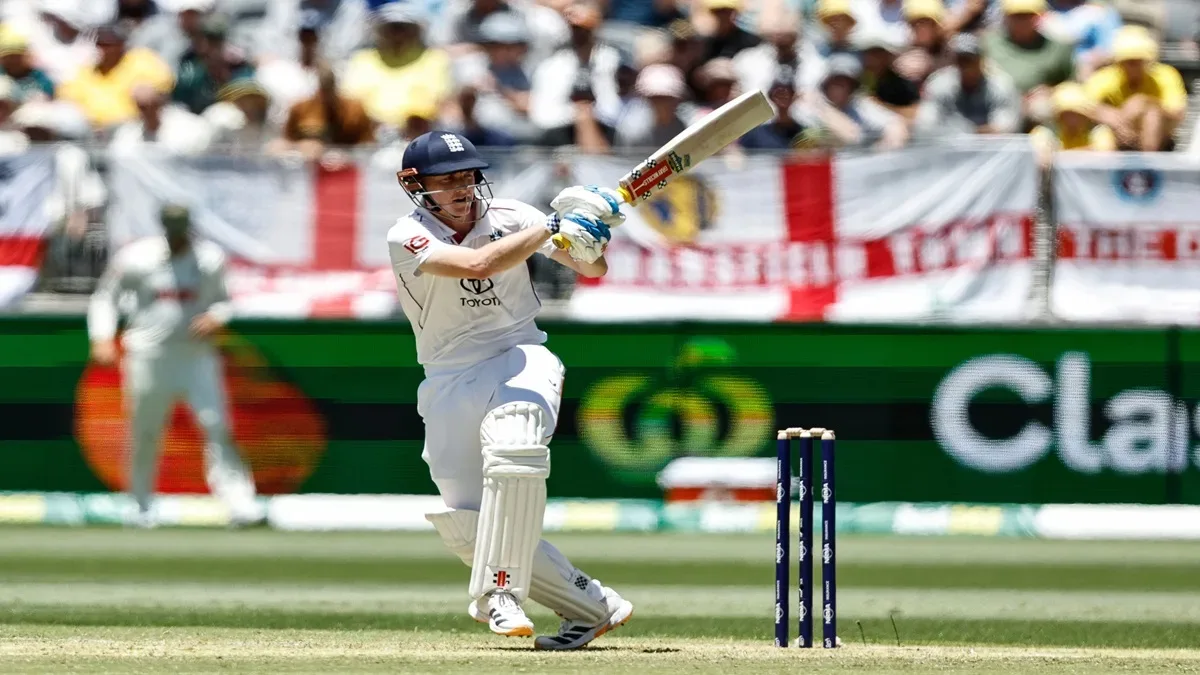
Australia will look to extend their 1-0 series lead when they face England in the second T20 international at Gold Coast Stadium on Tuesday, 24 November 2026. England must respond to their opening defeat without all-rounder Will Jacks, who has been ruled out of the remaining four matches with a broken hand.
Mitchell Marsh’s side secured a three-wicket victory at the Melbourne Cricket Ground on Saturday, successfully chasing England’s 187/9 with one ball remaining.
The result ended England’s seven-match winning streak in T20 internationals and gave Australia an early advantage in the five-match series.
Harry Brook’s side had arrived with confidence after winning the preceding ODI series 2-1. However, missed opportunities in Melbourne have left England facing an important contest on the Gold Coast.
The second T20 begins at 8.15 am GMT 6.15 pmm local time), with UK coverage available on TNT Sports.
Australia take momentum into the second T20
Embed from Getty ImagesAustralia recovered from a difficult position to win the opening match, with Nikhil Chaudhary and Jack Edwards producing the decisive contributions.
Chaudhary scored 66 from 38 deliveries, hitting six fours and two sixes. His innings kept Australia’s pursuit alive after England had removed Jake Fraser-McGurk early and dismissed Marsh for 37.
Sam Harper also impressed on his international debut, scoring 32 from just 15 balls.
Australia still required 20 runs from the final two overs when Chaudhary was dismissed.
Edwards responded with an unbeaten 25 from 11 balls, including a six from the first delivery of Sam Curran’s final over.
With 11 required from six deliveries, Australia completed the chase with one ball remaining.
According to Cricket Australia’s opening-match report, Chaudhary also returned bowling figures of 2-21, dismissing Harry Brook and Sam Curran.
His performance demonstrated the value of Australia’s emerging all-round options during a series in which several established internationals are unavailable.
Australia are without Pat Cummins and Josh Hazlewood, who have been rested ahead of the Test series against New Zealand. Mitchell Starc retired from T20 internationals in September 2025, while Travis Head and Josh Inglis are also absent as Australia manage their preparations for the forthcoming Tests.
Despite those absences, Marsh has a batting order capable of scoring quickly throughout the innings.
Tim David provides power in the middle order, while Fraser-McGurk, Harper and Edwards offer attacking options.
England cannot afford to assume that removing Australia’s leading batters will be enough to control the contest.
England face selection problems after Jacks’ injury
Embed from Getty ImagesEngland’s preparations suffered a setback when Jacks fractured his right hand while attempting a caught-and-bowled chance from Ben Dwarshuis during Saturday’s defeat.
The 28-year-old left the field in the penultimate over and has been ruled out of the remaining four matches.
He had earlier scored three runs and taken two wickets for 29 runs before leaving the field.
The International Cricket Council confirmed Jacks’ withdrawal on 22 November, with England expected to announce their replacement plans.
His absence removes an important spin-bowling option and reduces the flexibility of England’s batting order.
Jacks had been expected to captain England for the first time in the final T20 international in Canberra on 2 December. Tom Banton has since been appointed vice-captain and is expected to lead England when Harry Brook leaves the tour to prepare for the Test series against South Africa.
Brook and wicketkeeper Jordan Cox are due to leave Australia after the fourth T20 in Sydney to prepare for England’s Test series in South Africa. Hampshire seamer Scott Currie is scheduled to join England’s squad for the final match in Canberra on 2 December.
That makes Jacks’ injury particularly inconvenient for a squad already preparing to change personnel later in the series.
Uncapped all-rounder James Coles could make his international debut as England consider how to replace Jacks’ batting and off-spin. Jamie Overton and Liam Dawson offer alternative combinations, while Eddie Jack and Thomas Rew are also available for selection.
The selectors must consider whether to replace Jacks with another specialist batter or retain the additional bowling depth that his inclusion provided.
Harry Brook remains central to England’s response
Embed from Getty ImagesBrook produced England’s most influential batting performance in Melbourne, scoring 65 from 28 deliveries.
His innings included four boundaries and six sixes, with a half-century arriving from just 20 balls.
Alongside Tom Banton, who contributed 39 from 22 deliveries, Brook added 97 runs for the third wicket from 41 balls.
Their partnership transformed England’s innings after two early wickets.
However, Australia eventually restricted England to 187-9 despite dropping six catches.
England managed only 37 runs from their final five overs, losing four wickets during that period.
That slowdown proved costly.
A total above 200 had appeared possible while Brook and Banton were batting together, but England struggled to maintain their scoring rate once the partnership ended.
Brook will again be important at the Gold Coast, particularly against Adam Zampa and Chaudhary during the middle overs.
England’s wider white-ball development has placed considerable responsibility on their captain. World in Sport previously examined Brook’s leadership and batting responsibilities during England’s home series against India.
His attacking approach allows England to score heavily, although the Melbourne defeat demonstrated why partnerships and lower-order contributions remain important.
Phil Salt will also be looking for a better performance after falling to the opening delivery of the first match.
Banton’s recent ODI form offers England another source of confidence, while Curran and Dawson provide valuable batting options lower down the order.
Key battles that could decide the match
England’s ability to control Australia’s scoring during the powerplay will be important.
The opening six overs carry additional significance because fielding restrictions limit the number of players allowed outside the inner circle.
As explained in World in Sport’s guide to cricket powerplay regulations, those restrictions create opportunities for aggressive batting but also reward disciplined new-ball bowling.
England will want Henry Crocombe and their other seamers to challenge Australia’s top order before the middle overs.
Fraser-McGurk’s early dismissal in Melbourne demonstrated how quickly an aggressive opening batter can be removed.
However, Harper’s rapid innings also showed the danger of allowing Australia’s emerging players to settle.
Another important contest involves England’s batters against Australia’s spin attack.
Zampa remains an experienced wicket-taking option, while Chaudhary’s performance in Melbourne gives Marsh another effective bowler during the middle overs.
England will need to rotate the strike consistently rather than relying exclusively on boundaries.
The final overs could be equally important.
Curran conceded the decisive runs in Melbourne, but England’s problems were not limited to the final over. Their batting slowdown prevented them from setting a more demanding target.
For Australia, Edwards has already demonstrated his ability to finish a difficult chase under pressure.
Both captains will need to judge when to introduce their most effective bowlers and which match-ups offer the strongest opportunity to take wickets.
Australia and England team news
Australia are expected to retain a strong core from their opening victory, although their final XI will not be confirmed until the toss.
Marsh, Chaudhary, David, Harper and Edwards provide the main batting options.
Zampa remains a central figure in the bowling attack, with Ben Dwarshuis, Riley Meredith, Spencer Johnson and Billy Stanlake among Australia’s pace options.
Nathan Ellis remains unavailable with a side injury, while Xavier Bartlett and Mahli Beardman were ruled out after injuries sustained during the ODI series.
England have several decisions to make following Jacks’ withdrawal.
Brook will continue as captain, with Salt, Banton and Cox providing established batting options.
Adil Rashid offers leg-spin experience, while Dawson gives England an additional left-arm spin option.
Crocombe made his T20 international debut in Melbourne, and the touring squad includes other players seeking opportunities.
Neither side has confirmed its starting XI for the second match.
When is Australia vs England and how can fans watch?
The second T20 international takes place at People First Stadium, also referred to as Gold Coast Stadium, in Carrara, Queensland, on Tuesday, 24 November 2026.
Play is scheduled to begin at 8.15 am GMT, corresponding to 6.15 pm local time in Queensland.
TNT Sports will broadcast the match in the United Kingdom, with streaming available through HBO Max.
Australia enter the contest leading the five-match series 1-0.
Victory would move the hosts within one win of securing the series, while England can restore parity before the teams travel to Brisbane.
Remaining Australia vs England T20 fixtures
After Tuesday’s match, three further T20 internationals are scheduled.
- Friday, 27 November: Third T20I, The Gabba, Brisbane 8.15 amam GMT.
- Sunday, 29 November: Fourth T20I, Sydney Cricket Ground – 8.15 am GMT.
- Wednesday, 2 December: Fifth T20I, Manuka Oval, Canberra –8.15 amm GMT.
England need a stronger finish with the bat after managing just 37 runs from their final five overs in Melbourne.
Australia, meanwhile, can establish a 2-0 series advantage with victory on the Gold Coast before the teams meet again in Brisbane on Friday, 27 November.



Have your say
Join the debate
Share your view with other World in Sport readers below.