


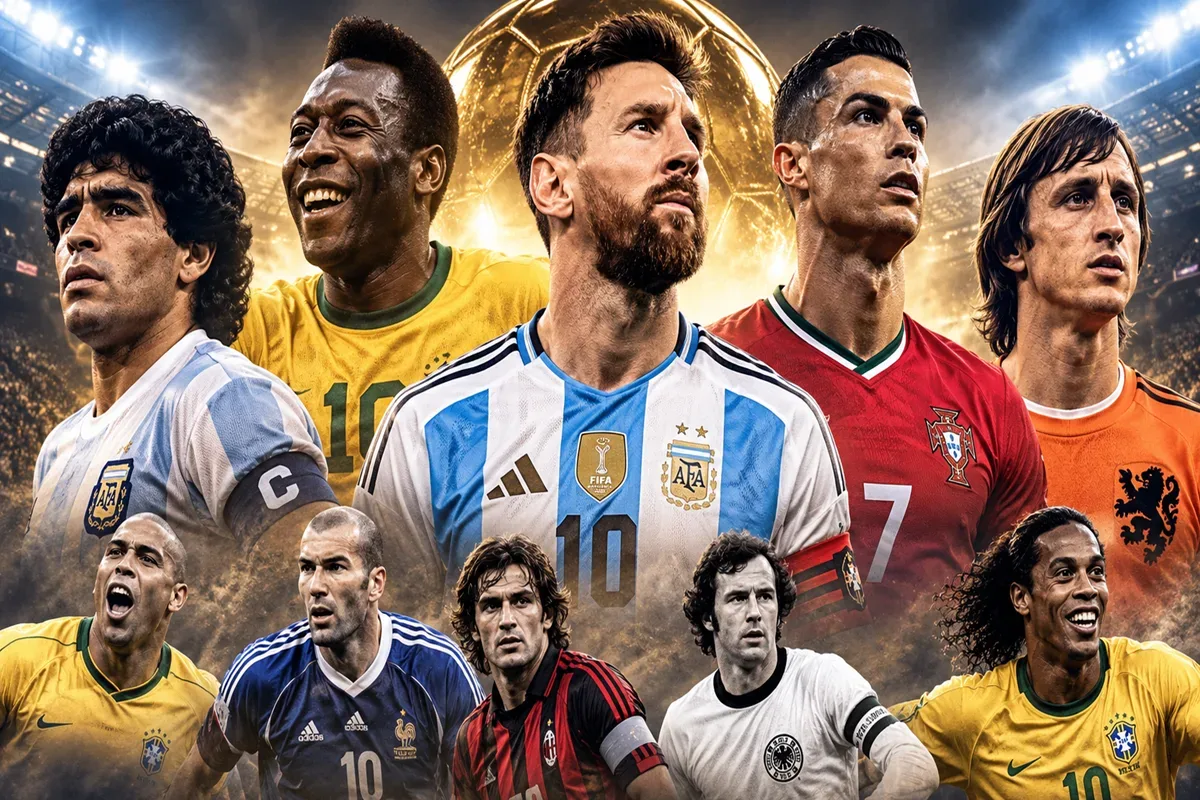
World in Sport ranks the 20 greatest footballers of all time, with Lionel Messi first, followed by Pelé, Diego Maradona and Cristiano Ronaldo. The ranking compares players across eras using peak ability, longevity, club and international success, individual awards and influence on football.
The profiles highlight defining achievements, including Pelé’s three World Cups, Maradona’s 1986 campaign, Ronaldo’s Champions League record and Johan Cruyff’s tactical influence. The list also includes legends such as Beckenbauer, Di Stéfano, Maldini, Xavi, Iniesta and Ronaldinho.
Lionel Messi leads World in Sport’s ranking of the greatest footballers of all time, ahead of Pelé, Diego Maradona and Cristiano Ronaldo.
There can never be a completely objective answer to football’s biggest individual debate. The sport has changed too much across generations. Players have competed under different laws, tactical systems, schedules, pitches and physical demands.
Individual awards also require context. The Ballon d’Or, for example, has changed its eligibility rules during its history. Comparing raw award totals across eras therefore cannot settle the argument on its own.
Instead, World in Sport has considered peak performance, longevity, club success, international achievement, influence on the game and how strongly each player shaped his era.
Messi takes first place because he combines almost every measure. His career includes a World Cup, continental success with Argentina, sustained club dominance and a record eight Ballon d’Or awards.
The debate does not end there. Pelé remains football’s only three-time men’s World Cup winner. Maradona produced one of the competition’s defining individual campaigns in 1986, while Ronaldo built a scoring record across different leagues and generations that few players can approach.
Embed from Getty ImagesHow World in Sport ranked the greatest footballers
Trophies matter, but football is a team sport. Simply counting medals would favour players from dominant clubs and countries.
Individual numbers also require context. A centre-forward naturally scores more goals than a defender. Modern players have access to competitions and statistical records that did not exist for earlier generations.
The ranking therefore considers six broad areas: individual ability, peak performance, longevity, major trophies, international impact and influence on football.
The result is not intended to close the argument. It provides a reasoned comparison of players whose careers unfolded in very different versions of the same sport.
| Rank | Player | Nation | Defining achievements |
|---|---|---|---|
| 1 | Lionel Messi | Argentina | World Cup winner, eight Ballon d’Or awards, four Champions League titles |
| 2 | Pelé | Brazil | Three World Cups, Santos icon, global football pioneer |
| 3 | Diego Maradona | Argentina | 1986 World Cup winner and Golden Ball, Napoli legend |
| 4 | Cristiano Ronaldo | Portugal | Five Ballon d’Or awards, five Champions League wins, European champion |
| 5 | Johan Cruyff | Netherlands | Three Ballon d’Or awards, three European Cups with Ajax |
| 6 | Alfredo Di Stéfano | Argentina/Spain | Five successive European Cups, eight Spanish league titles |
| 7 | Franz Beckenbauer | West Germany | World Cup-winning captain, two Ballon d’Or awards, three European Cups |
| 8 | Ronaldo Nazário | Brazil | Two Ballon d’Or awards, two-time World Cup winner, 2002 Golden Shoe |
| 9 | Zinedine Zidane | France | World Cup and European Championship winner, 1998 Ballon d’Or |
| 10 | Ferenc Puskás | Hungary | Hungary great, Real Madrid legend, four goals in 1960 European Cup final |
| 11 | Garrincha | Brazil | World Cup winner in 1958 and 1962, outstanding performer in 1962 |
| 12 | Michel Platini | France | Three consecutive Ballon d’Or awards, nine goals at EURO 1984 |
| 13 | Paolo Maldini | Italy | Five European Cups, seven Serie A titles |
| 14 | Xavi | Spain | World Cup, two European Championships, four Champions League titles |
| 15 | Andrés Iniesta | Spain | World Cup-winning goal, two European Championships, four Champions Leagues |
| 16 | Lev Yashin | Soviet Union | Only goalkeeper to win the Ballon d’Or |
| 17 | Gerd Müller | West Germany | World Cup and European champion, 1970 Ballon d’Or |
| 18 | George Best | Northern Ireland | European Cup winner and 1968 Ballon d’Or recipient |
| 19 | Eusébio | Portugal | 1965 Ballon d’Or, European Cup winner, 1966 World Cup top scorer |
| 20 | Ronaldinho | Brazil | World Cup winner, Champions League winner, 2005 Ballon d’Or |
1. Lionel Messi
No player offers a stronger overall case than Lionel Messi.
His Barcelona years provided an extraordinary combination of scoring, creativity and control. Messi could start an attack, create the decisive pass or finish it himself. His low centre of gravity and close control allowed him to change direction without surrendering possession.
The individual honours are unprecedented. Messi has won eight Ballon d’Or awards, more than any other player.
For years, the major gap in his record concerned Argentina. That changed when he captained his country to the Copa América in 2021 and the 2022 World Cup, before Argentina retained the Copa América in 2024.
Messi scored seven times in Qatar, including twice in the final against France, and won the tournament’s Golden Ball. He returned for a sixth World Cup in 2026 and scored eight goals as Argentina reached another final, where Spain won 1-0 after extra time. Messi ended his World Cup career with 21 goals before announcing his retirement from international football on 31 August 2026.
World in Sport’s Lionel Messi profile explores the full development of a career that transformed Barcelona and eventually delivered Argentina’s biggest prize.
Longevity separates Messi from many brilliant players with shorter peaks. His combination of goals, assists, trophies, individual awards and international success gives him the strongest all-round record in this ranking.
2. Pelé
Pelé’s claim begins with a record no other male footballer has matched.
He won the World Cup with Brazil in 1958, 1962 and 1970. FIFA’s record of Pelé’s three titles confirms that he remains the only man to win the competition three times.
He was only 17 when he scored six goals at the 1958 tournament, including two in Brazil’s 5-2 final victory over Sweden.
Injury restricted his contribution in 1962, but he returned as the senior attacking figure in Brazil’s celebrated 1970 side. Pelé scored in the final as Brazil defeated Italy 4-1.
His club career was spent principally with Santos, where his performances helped make the Brazilian club a global attraction.
Comparisons of Pelé’s precise career goal total require care because different sources count friendly and exhibition matches differently. That statistical debate should not obscure his competitive record or influence.
The World in Sport Pelé profile examines how his success with Santos and Brazil helped make him football’s first truly global superstar.
3. Diego Maradona
Few careers demonstrate individual influence more clearly than Diego Maradona’s.
Mexico 1986 remains the centrepiece.
Maradona captained Argentina to the World Cup and won the Golden Ball. He scored five goals during the tournament and produced defining performances in the knockout rounds.
His quarter-final against England contained both controversy and brilliance. His first goal came from the infamous handball. His second followed a run from inside his own half and was later voted FIFA’s World Cup Goal of the Century.
Maradona then scored twice against Belgium in the semi-final before creating the decisive opening for Jorge Burruchaga in Argentina’s 3-2 final victory over West Germany.
His club legacy adds another dimension. Maradona inspired Napoli to the first two Serie A championships in their history during his spell in southern Italy.
The World in Sport Diego Maradona profile examines both the football and the controversies that accompanied one of the sport’s most complicated careers.
Messi has the stronger long-term record in this ranking. Pelé has unmatched World Cup success. Maradona’s argument rests heavily on peak influence. At his best, an entire team could appear to revolve around him.
Embed from Getty Images4. Cristiano Ronaldo
Cristiano Ronaldo’s greatest strength in this debate is the scale and duration of his production.
He developed from a skilful winger at Sporting CP and Manchester United into one of football’s most prolific forwards.
Ronaldo won the Champions League with Manchester United before adding four more titles at Real Madrid. UEFA continues to list him as the competition’s all-time leading scorer.
Its Champions League record summary also records his five final victories.
He has won five Ballon d’Or awards. Only Messi has collected more.
Internationally, Ronaldo captained Portugal to the EURO 2016 title and UEFA Nations League triumphs in 2019 and 2025. In 2026, he became the first man to score at six different World Cups before Portugal lost 1-0 to Spain in the last 16. Ronaldo subsequently confirmed that it had been his final World Cup.
His career also demonstrates unusual adaptability. Ronaldo succeeded in the Premier League, La Liga and Serie A while changing his playing style as he aged.
The World in Sport Cristiano Ronaldo profile looks more closely at that evolution.
Messi ranks higher here because of his broader creative influence and World Cup success. Ronaldo’s longevity, goalscoring and Champions League record nevertheless place him firmly among football’s defining players.
5. Johan Cruyff
Johan Cruyff’s place rests on both performance and influence.
He became the central figure of the Ajax team that won three consecutive European Cups from 1971 to 1973. He also won the Ballon d’Or three times.
Cruyff then helped take the Netherlands to the 1974 World Cup final.
His importance extended beyond individual statistics. Cruyff became closely associated with the ideas behind Total Football, in which movement and positional interchange challenged fixed traditional roles.
He later carried many of those principles into coaching, particularly at Barcelona.
Few players have influenced how football is played and how it is understood as deeply as Cruyff.
6. Alfredo Di Stéfano
Alfredo Di Stéfano became the driving force behind the first great Real Madrid dynasty.
Madrid won the first five European Cups between 1956 and 1960. Di Stéfano played and scored in every final.
The sequence culminated in the 7-3 victory over Eintracht Frankfurt at Hampden Park in 1960. Di Stéfano scored three times, while Ferenc Puskás struck four.
He also won eight Spanish league championships with Madrid.
The major gap is the World Cup. Di Stéfano never appeared at the tournament. He won official senior caps for Argentina and Spain and also played four matches for a Colombian representative side, although those appearances are not recognised as official FIFA internationals.
His club influence was so great, however, that any serious historical ranking has to account for him.
7. Franz Beckenbauer
Franz Beckenbauer proved that a defender could control a match rather than simply stop opponents.
Operating as a libero, he stepped out of defence with the ball and helped turn defensive possession into attacks.
Beckenbauer captained West Germany to the 1974 World Cup and helped Bayern Munich win three consecutive European Cups between 1974 and 1976.
He also won the Ballon d’Or in 1972 and 1976, an unusual achievement for a defensive player.
His tactical influence remains part of his legacy. Generations of ball-playing central defenders have followed a pathway that Beckenbauer helped establish.
8. Ronaldo Nazário
Before serious knee injuries interrupted his career, Ronaldo Nazário produced one of football’s most explosive attacking peaks.
The Brazilian combined sprinter-level acceleration with close control and the strength to stay upright through challenges. Defenders often faced the unusual problem of a centre-forward capable of collecting the ball well outside the penalty area and creating his own chance.
Ronaldo won the Ballon d’Or in 1997 and 2002.
He was part of Brazil’s 1994 World Cup-winning squad before becoming their main attacking figure at later tournaments.
His greatest international moment came in 2002. After years of injury problems, Ronaldo scored eight goals to win the tournament’s Golden Boot. Two came in Brazil’s 2-0 final victory over Germany.
World in Sport’s Ronaldo R9 profile examines how his mixture of speed, power and technique changed expectations of the modern striker.
9. Zinedine Zidane
Zinedine Zidane built his reputation on control and major-match influence.
The clearest example came in the 1998 World Cup final. Zidane scored twice as France defeated Brazil 3-0 to win their first world title.
Two years later, France won EURO 2000.
At club level, Zidane played for Juventus and Real Madrid. His left-footed volley against Bayer Leverkusen decided the 2002 Champions League final.
His final World Cup in 2006 produced another series of influential displays. Zidane won the tournament’s Golden Ball, although his playing career ended with his sending-off against Italy in the final.
The World in Sport Zinedine Zidane profile looks at both sides of a career defined by extraordinary technique and occasional losses of discipline.
10. Ferenc Puskás
Ferenc Puskás was the leading figure of Hungary’s great national team of the early 1950s.
Hungary went more than four years without defeat before losing 3-2 to West Germany in the 1954 World Cup final. Puskás had helped the side transform perceptions of international football, including during the famous 6-3 victory over England at Wembley in 1953.
His second great career came at Real Madrid.
Puskás scored four times in Madrid’s 7-3 victory over Eintracht Frankfurt in the 1960 European Cup final. Di Stéfano scored the other three.
His left foot, finishing and movement made him one of the most feared goalscorers of his generation.
11. Garrincha
Garrincha gave Brazil a different kind of attacking threat.
The winger helped Brazil win the 1958 World Cup alongside Pelé. Four years later, his importance increased dramatically after Pelé suffered an injury early in the tournament.
Garrincha drove Brazil through the knockout rounds in Chile. He scored twice against England in the quarter-final and twice against the hosts in the semi-final as Brazil retained the trophy.
His dribbling was unpredictable even by elite standards. He repeatedly beat defenders who knew exactly what he intended to attempt.
12. Michel Platini
Michel Platini produced one of the great international tournament performances at EURO 1984.
The France captain scored nine goals in five matches as the hosts won their first major international trophy. That remains the record for most goals by a player in a single European Championship finals tournament.
Platini also won three consecutive Ballon d’Or awards from 1983 to 1985.
He combined playmaking with unusual goalscoring output for a midfielder and became the central attacking figure for both France and Juventus.
13. Paolo Maldini
Longevity at the highest level defines Paolo Maldini’s case.
The defender spent his entire senior club career with AC Milan and played at left-back and centre-back.
Maldini won five European Cups across three different decades. He also collected seven Serie A championships and made 902 appearances for Milan.
He reached the 1994 World Cup final with Italy and remained an elite defender deep into his thirties.
Unlike most players near the top of all-time lists, Maldini did not build his reputation around goals or creative statistics. Positioning, anticipation and consistency provided his value.
14. Xavi
Xavi became the passing controller of two historically successful teams.
Barcelona relied on his ability to dictate rhythm and keep possession moving through midfield. Spain used the same qualities during the most successful international period in their history.
Xavi helped Spain win EURO 2008, the 2010 World Cup and EURO 2012. With Barcelona, he collected four Champions League titles and eight Spanish championships.
He rarely dominated matches through individual runs or spectacular scoring numbers. He controlled them through decisions.
15. Andrés Iniesta
Andrés Iniesta shared Barcelona and Spain’s midfield with Xavi but offered a different type of threat.
His dribbling allowed him to escape pressure and move possession into dangerous areas.
The defining moment came in Johannesburg in 2010. Iniesta scored the extra-time winner against the Netherlands to give Spain their first World Cup.
He also won EURO 2008 and was named Player of the Tournament when Spain retained the European Championship in 2012. His club honours included four Champions League titles with Barcelona.
Embed from Getty Images16. Lev Yashin
Lev Yashin gives goalkeepers representation in a debate usually dominated by attacking players.
The Dynamo Moscow and Soviet Union goalkeeper won the Ballon d’Or in 1963. He remains the only goalkeeper to receive the men’s award.
Yashin developed a reputation for commanding his penalty area rather than remaining close to his goal line. His approach helped expand ideas about what a goalkeeper could contribute.
17. Gerd Müller
Gerd Müller made goalscoring look simple because his movement regularly put him in the right place before defenders could react.
He scored 68 times in 62 appearances for West Germany and 365 goals in 427 Bundesliga matches for Bayern Munich.
Müller won EURO 1972 and scored the winning goal in the 1974 World Cup final against the Netherlands.
He also won the 1970 Ballon d’Or and formed part of Bayern’s three consecutive European Cup-winning teams.
Few penalty-box forwards have matched his efficiency.
18. George Best
George Best combined balance, dribbling, acceleration and finishing at Manchester United.
His greatest season came in 1967/68.
United became the first English club to win the European Cup when they defeated Benfica 4-1 after extra time at Wembley. Best scored during the final and later received the 1968 Ballon d’Or.
Northern Ireland’s failure to reach a major tournament during Best’s international career limits direct comparisons with players who built reputations at World Cups.
At club level, his peak remains one of British football’s most celebrated.
19. Eusébio
Eusébio combined exceptional acceleration with powerful finishing.
He won the European Cup with Benfica in 1962 and received the Ballon d’Or in 1965.
The 1966 World Cup brought his defining international performance. Eusébio scored nine times as Portugal finished third, which remains their best World Cup placing.
His four goals in Portugal’s 5-3 quarter-final comeback against North Korea remain one of the competition’s great individual knockout performances.
20. Ronaldinho
Ronaldinho’s absolute peak did not last as long as those of several players above him, but few footballers have combined effectiveness and improvisation so naturally.
He won the 2002 World Cup with Brazil before becoming Barcelona’s central attacking figure.
Ronaldinho collected the Ballon d’Or in 2005 and helped Barcelona win the Champions League the following season.
At his best, he could change a match through a pass, dribble, free-kick or unexpected piece of technique.
His relatively short period at the very highest level keeps him outside the top 15, but his peak demands inclusion in the wider discussion.
Who is the greatest footballer ever?
Messi takes first place in this ranking because his case does not depend on one area of achievement.
He combined elite goalscoring with playmaking. He remained among the world’s leading players for an exceptionally long period. He dominated club football and eventually added the World Cup to his international record.
Pelé’s three World Cups remain unmatched. Maradona’s 1986 campaign provides perhaps the strongest argument for individual influence at a single major tournament. Cristiano Ronaldo’s longevity, goalscoring and European record give him another distinct route into the debate.
Cruyff changed football beyond his own performances. Beckenbauer reshaped expectations of defenders. Di Stéfano became the central figure in the first European Cup dynasty.
That variety is why the argument survives every generation.
Let us know your greatest footballer of all time in the comments.


Have your say
Join the debate
Share your view with other World in Sport readers below.