
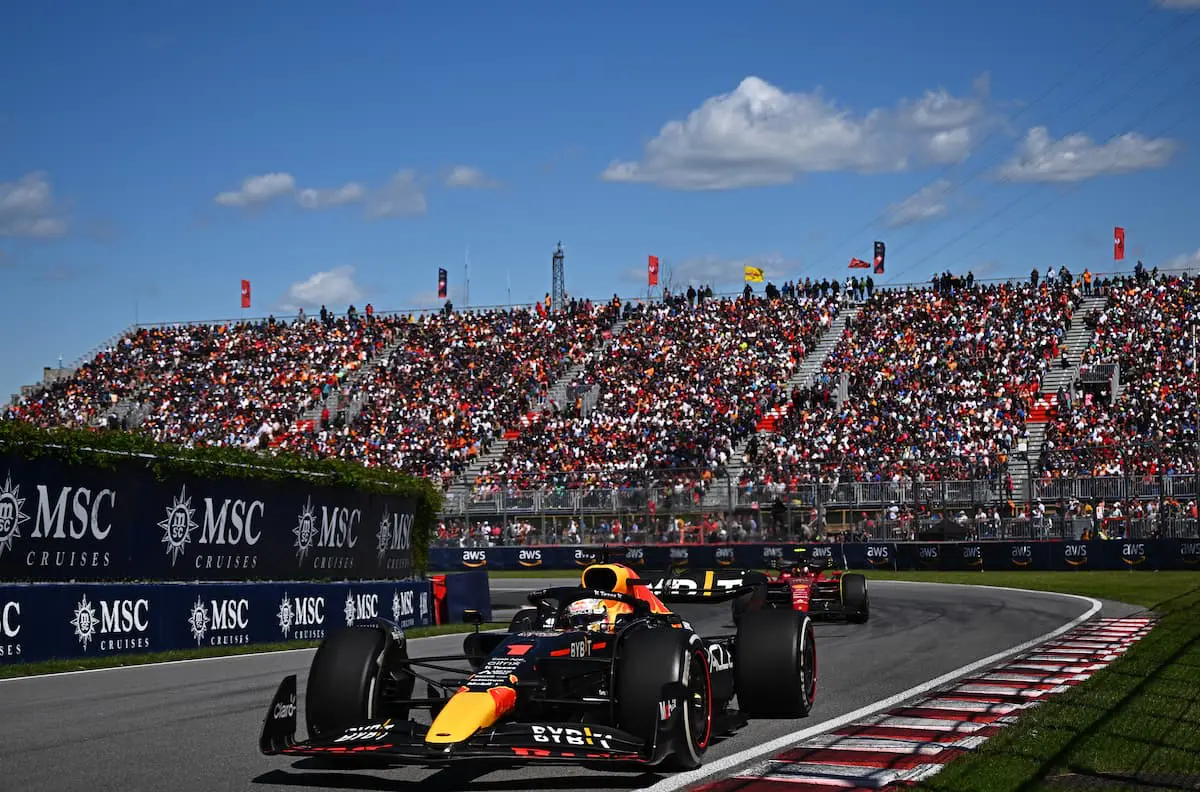
It’s round nine of the Formula 1 season, and we travel North West across the pond to host The Canadian Grand Prix. Celebrated for its vibrant atmosphere and challenging circuit, the track is home to Circuit Gilles Villeneuve in Montreal, Quebec. This race combines high-speed straights and challenging chicanes, making it a favourite among drivers and fans.
Overview of the Canadian Grand Prix
Embed from Getty ImagesAs a part of the Formula 1 World Championship, the Canadian Grand Prix first became a part of the series in 1967. Which was initially held at Mosport Park in Ontario before alternating with Mont-Tremblant later in the year. As of 1978, however, the race has been returning to Montreal every year to run at the Île Notre-Dame, a man made island in the St. Lawrence River that was created as part of World War II. Many memorable Formula 1 moments took place at this circuit throughout its history. All of them are named after Canadian racing legend Gilles Villeneuve, who tragically passed away in 1982.
Track Layout
Embed from Getty Images70 laps, clockwise circuit, the Circuit Gilles Villeneuve creates 305 kilometres of high-speed adrenaline. In terms of distance, the circuit is 4,361 kilometres (2,710 miles) long. Featuring 14 turns, the race track combines tight corners with sections at high speeds. Pushing both machine and drivers to the limit and top speed.
Iconic Features
Embed from Getty ImagesIn case you are unfamiliar with the circuit, what makes Canada iconic is the famous, “Wall of Champions.” A barrier at the exit of the final chicane that has claimed the cars of several world champions throughout the years. This includes Damon Hill, Michael Schumacher, and Jacques Villeneuve, and even Sebastian Vettel in 2011.
Another feature is the slow hairpin at Turn 10, then turning down to Turn 11 the drivers can accelerate down to Turn 12 and 13. Avoid the “Wall of Champions” and continue to push to the line heading down to Turn 1.
The Circuit Gilles Villeneuve consists of three DRS zones, the first zone comes out the twisty corners of Turn 6 and Turn 7. Racing down to Turn 8. The second DRS zone, is located before Turn 12 passing the speed before Turn 13. Within three seconds riding the curbs of Turn 13 and Turn 14 and the final DRS zone is in sight, passing the start/finish line before braking for the heavy Turn 1.
Memorable Races Around The Canadian Grand Prix
Embed from Getty ImagesThere have been many dramatic races at the Canadian Grand Prix over the years. In 2011, Jenson Button’s victory over Sebastian Vettel. Button made six pit stops during the race and was able to overcome several setbacks, including a collision with his Hamilton and Alonso. The race, which lasted over four hours due to rain, remains to this day as the longest in race Formula 1 history. Finally, another memorable moment in the career of Lewis Hamilton was in 2007. When he won his first Formula One race, which paved the way for a distinguished career ahead of him.
Live Timings
Embed from Getty ImagesThursday (6th June)
7:30 pm – Live Drivers’ Press Conference
Friday (7th June)
6 pm – The Canadian Grand Prix Practice One – (Session begins at 6:30 pm)
9:45 pm – The Canadian Grand Prix Practice Two – (Session begins at 10 pm)
Saturday (8th June)
5:15 pm – The Canadian Grand Prix Practice Three – (Session begins at 5:30 pm)
8 pm – The Canadian Grand Prix Qualifying – (Session begins at 9 pm)
Sunday (9th June)
5:30 pm – The Canadian Grand Prix – (Session begins at 7 pm)
If you would like to learn more news about the world of Formula 1? If you would like to learn more news about the world of Formula 1? “Sergio Perez Signs New Two-Year Deal with Red Bull Racing!” or “Esteban Ocon Set to Leave Alpine at the End of the 2024 Season”
Image Credit: Red Bull Content Pool
