

Under the shimmering lights of Mercedes-Benz Stadium, what was billed as a high-energy Eastern Conference clash instead unfolded like a slow-burning fuse that never quite reached the fireworks. Atlanta United and D.C. United battled to a frustrating 0-0 draw—one that had moments of intrigue, flashes of promise, but ultimately left supporters yearning for something—anything—decisive.
Kickoff: A Bright Start That Quickly Dimmed
The opening whistle brought a surge of anticipation from the Five Stripes faithful. Atlanta, eager to build momentum at home, pressed early. The midfield triangle snapped passes quickly, probing for gaps in D.C.’s defensive block. Within the first five minutes, Atlanta nearly carved out a breakthrough—an incisive run down the right flank led to a low cross that flashed dangerously across the six-yard box, just evading a sliding attacker.
It was the kind of chance that hinted at a long night for D.C. United. But that early spark faded almost as quickly as it ignited.
D.C. settled into their shape, compact and disciplined, forcing Atlanta into wider areas and limiting space between the lines. Their approach was clear: frustrate, absorb, and counter when possible. And for long stretches of the first half, it worked to perfection.
Midfield Stalemate: Where Attacks Went to Die
By the 20-minute mark, the match had settled into a predictable rhythm. Atlanta controlled possession but struggled to translate it into meaningful chances. Passes circulated side-to-side, the tempo slowing as D.C.’s defensive lines held firm.
Atlanta’s creative players tried to unlock the defence with quick one-twos and diagonal runs, but timing was just off. A through ball here was slightly overhit; a promising run there was mistimed by a fraction. The cohesion wasn’t there.
D.C., meanwhile, showed little ambition going forward. Their counterattacks fizzled out quickly, often ending in hopeful long balls that Atlanta’s backline dealt with comfortably. The visitors seemed content to let the clock tick, confident in their defensive organisation.
Best Chance of the Half and It Wasn’t Much
The first half’s clearest opportunity came in the 38th minute. Atlanta worked the ball patiently before finding space just outside the box. A curling effort from distance looked destined for the top corner—until D.C.’s goalkeeper Sean Johnson produced a sharp diving save, tipping it over the bar.
The crowd roared in appreciation, but it was a fleeting moment in an otherwise uneventful half. As the referee blew for halftime, the scoreboard read 0-0—a fair reflection of a game that lacked cutting edge.
Second Half: More Energy, Same Outcome
Atlanta emerged from the break with renewed urgency. The tempo picked up, the pressing intensified, and for a brief stretch, it looked like the breakthrough might finally come.
In the 52nd minute, a clever flick in the box created chaos, with the ball ricocheting between defenders before falling kindly to Miguel Almiron. The shot came quickly—but again, D.C.’s goalkeeper Sean Johnson was equal to it, smothering the effort and preserving the deadlock.
The home crowd sensed the shift and tried to will their team forward. Chants echoed around the stadium, urging Atlanta to push harder, take risks, and find that elusive goal. But D.C. refused to crack.
Tactical Chess Match Turns into a Grind
As the minutes ticked away, the match began to feel less like a contest and more like a stalemate neither side could escape. Atlanta continued to dominate possession, but their attacks became increasingly predictable: crosses into crowded areas, speculative long-range shots, and hopeful passes that rarely found their mark.
D.C., for their part, showed little interest in changing the script. Their defensive discipline bordered on stubbornness, with every player committed to the shape. When they ventured forward, they lacked numbers and convictions. Substitutions came and went, but they failed to alter the rhythm. Fresh legs injected a brief burst of energy, but the overall pattern remained unchanged.
Late Drama Almost
Source: Shutterstock
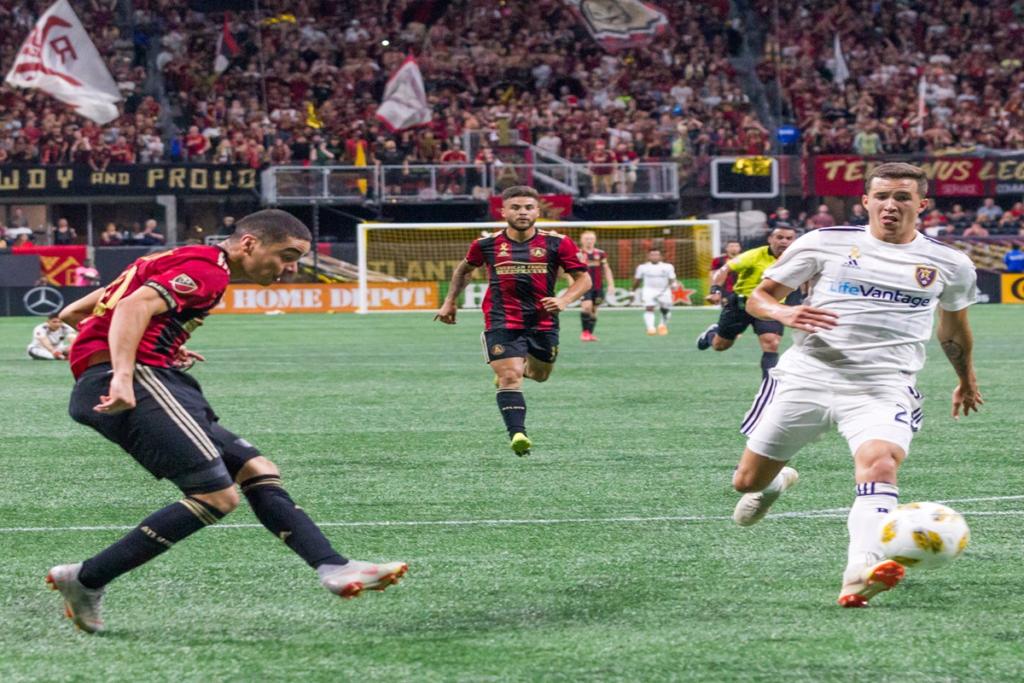
The closest Atlanta came to breaking the deadlock was in the 83rd minute. Atlanta whipped in a dangerous corner that found a leaping header at the near post. The ball glanced toward goal—only to be cleared off the line in a desperate defensive effort. For a split second, the stadium held its breath. Then came the groan as the chance slipped agonisingly away.
Moments later, D.C. had a rare opportunity of their own, a quick counter that caught Atlanta slightly off balance. A low shot from the edge of the box forced a scrambling save, but it lacked the power to truly trouble the goalkeeper. That was the story of the night: half-chances, near-misses, and just not enough quality.
Final Whistle: Frustration Over Flair
When the referee signalled full time, there was no sense of celebration—only frustration. Atlanta’s players walked off knowing they had dominated large portions of the game but failed to deliver the final product. D.C., meanwhile, would likely view the result as a job well done—a hard-earned point on the road.
For Atlanta, questions remain. Possession alone isn’t enough. Control without creativity, dominance without danger—it’s a formula that won’t win many matches. For D.C., the defensive solidity is encouraging, but their lack of attacking ambition may come back to haunt them in future fixtures.
In the end, this was a match that promised excitement but delivered endurance. A chess match without a checkmate. A story without a climax. And sometimes, in soccer, that’s the most frustrating result of all.
Very interesting read and perspective 👌