


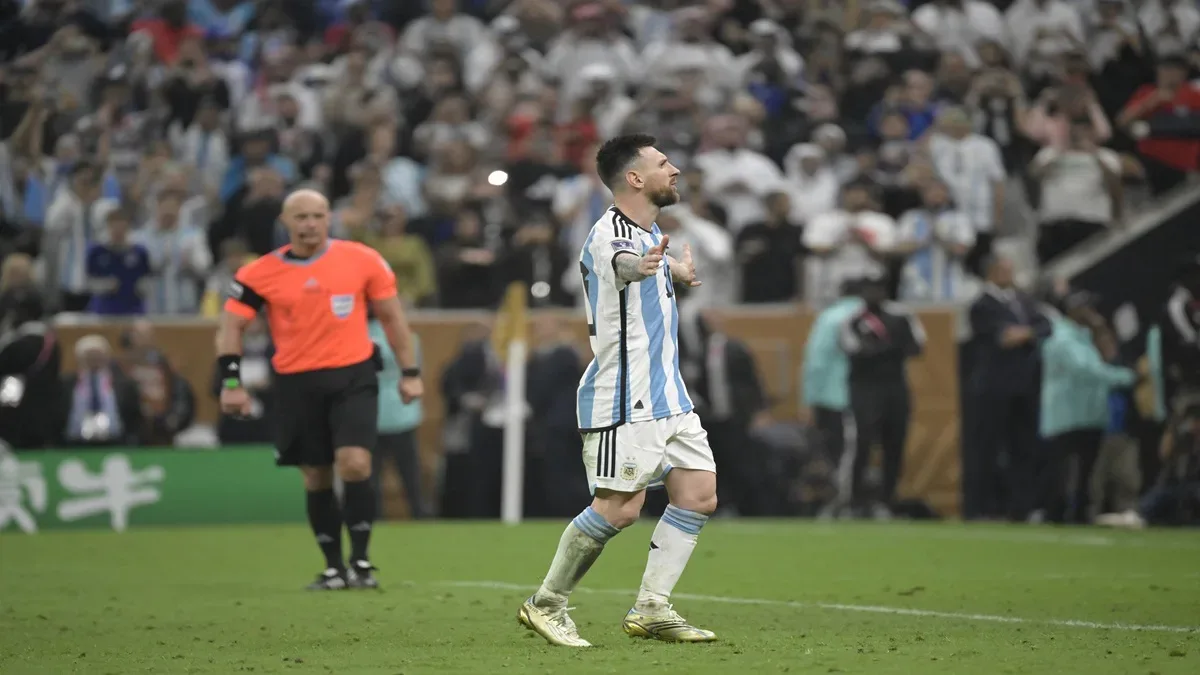
World in Sport ranks the 15 greatest men’s FIFA World Cup matches, with Argentina’s 2022 final victory over France in first place. The selection considers footballing quality, drama, opposition, historical significance and the importance of each result.
Other featured matches include Italy’s 1970 semi-final, the 1954 Miracle of Bern, England’s 1966 triumph, Maradona’s 1986 performance, Brazil’s 2014 defeat by Germany and England’s 2026 win over France.
The 2022 World Cup final between Argentina and France tops World in Sport’s ranking of the greatest men’s FIFA World Cup matches of all time. Lionel Messi’s Argentina eventually won 4-2 on penalties after a remarkable 3-3 draw, overcoming Kylian Mbappé’s hat-trick to secure their third world title.
Yet the competition’s history offers plenty of challengers. Italy’s extraordinary 4-3 victory over West Germany in 1970. The Miracle of Bern in 1954 and France’s dramatic semi-final defeat to West Germany in 1982 all belong among football’s most memorable matches.
The 2026 tournament added another contender when England beat France 6-4 in an extraordinary third-place play-off in Miami.
Ranking matches across different generations is inevitably subjective. World in Sport has considered the standard of football, dramatic moments, quality of opposition, historical significance and importance of the result.
A World Cup final naturally carries greater weight than a group match. However, a stunning individual performance, an unexpected comeback or exceptional attacking football can make an earlier-round encounter equally memorable.
These 15 matches represent the moments when the World Cup delivered something far beyond an ordinary international fixture.
The 15 greatest World Cup matches ranked
1. Argentina 3-3 France – 2022 final
18 December 2022 | Lusail Stadium, Qatar | Argentina won 4-2 on penalties
Embed from Getty ImagesFew football matches have combined individual brilliance, extraordinary drama and historical significance quite like the 2022 World Cup final.
Argentina appeared to have complete control. Messi converted an early penalty before Ángel Di María finished a flowing counter-attack to establish a 2-0 lead.
France struggled to create anything meaningful until the closing stages. Then Mbappé changed everything.
He converted an 80th-minute penalty and scored again almost immediately to force extra time. Messi restored Argentina’s lead in the 108th minute, only for Mbappé to complete his hat-trick with another penalty.
Both teams had opportunities to win before the shootout. Emiliano Martínez made a crucial late save from Randal Kolo Muani, preserving Argentina’s hopes.
Argentina eventually prevailed 4-2 on penalties, with Gonzalo Montiel converting the decisive kick.
FIFA’s retrospective of the 2022 final documents the extraordinary sequence of goals and late chances.
The final also provided a defining moment in Messi’s international career. Argentina claimed their first World Cup since 1986, while Mbappé became only the second player to score a hat-trick in a men’s World Cup final.
Messi’s achievement further strengthened his position among the greatest footballers of all time.
The combination of six goals, two comebacks, extra-time drama and the significance of Messi’s triumph earns this match first place.
2. Italy 4-3 West Germany – 1970 semi-final
17 June 1970 | Estadio Azteca, Mexico City | After extra time
The 1970 World Cup semi-final between Italy and West Germany became known as the Game of the Century.
Its reputation rests largely on an extraordinary period of extra time.
Italy led through Roberto Boninsegna’s eighth-minute goal and appeared set for a narrow victory. However, Karl-Heinz Schnellinger equalised deep into second-half stoppage time.
What followed transformed the match.
Gerd Müller put West Germany ahead in extra time before Tarcisio Burgnich and Gigi Riva restored Italy’s advantage.
Müller struck again to make it 3-3, but Gianni Rivera responded almost immediately with the winning goal.
Five goals arrived during extra time, a record that still defines the match’s place in World Cup history. 1970 FIFA World Cup Mexico
Franz Beckenbauer also continued playing despite suffering a dislocated shoulder, with West Germany having already used both permitted substitutions.
The match offered a remarkable contrast between Italy’s defensive organisation and West Germany’s determination to attack.
Italy reached the final, where they lost 4-1 to the legendary Brazil 1970 World Cup team.
Although Italy finished as runners-up, their semi-final remains one of the competition’s most celebrated encounters.
3. West Germany 3-3 France – 1982 semi-final
8 July 1982 | Seville, Spain | West Germany won 5-4 on penalties
The 1982 semi-final in Seville delivered six goals, an extraordinary comeback and the first penalty shootout in World Cup history.
Pierre Littbarski gave West Germany the lead before Michel Platini equalised from the penalty spot.
The match also featured a deeply controversial collision between West German goalkeeper Harald Schumacher and France defender Patrick Battiston. Battiston suffered serious injuries, but the referee awarded no foul.
With the score 1-1 after 90 minutes, France took command.
Marius Trésor and Alain Giresse scored during the opening stages of extra time, putting France 3-1 ahead.
West Germany refused to surrender.
Karl-Heinz Rummenigge reduced the deficit before Klaus Fischer equalised with an acrobatic finish.
The score remained 3-3, sending the contest into a historic shootout. FIFA
West Germany eventually won 5-4 after Schumacher saved the decisive French attempt from Maxime Bossis.
FIFA’s account of the World Cup’s first penalty shootout underlines the match’s historical importance.
The football, controversy and rapid swings in momentum make the Night of Seville one of the tournament’s defining semi-finals.
4. Italy 3-2 Brazil – 1982 second group stage
5 July 1982 | Sarrià Stadium, Barcelona
Brazil entered the 1982 World Cup with an attacking side featuring Zico, Sócrates, Falcão and Éder.
Their football had captivated supporters, but Italy exposed the danger of relying on attacking quality without sufficient defensive control.
Paolo Rossi opened the scoring after five minutes. Sócrates quickly equalised, but Rossi struck again to restore Italy’s lead.
Brazil continued attacking and eventually found another equaliser through Falcão in the 68th minute.
At 2-2, Brazil were heading into the semi-finals because a draw would have been enough to advance.
Rossi completed his hat-trick six minutes later, securing a 3-2 victory for Italy. FIFA
Brazil could not respond for a third time.
It was a remarkable turnaround for Rossi, who had struggled to find his scoring touch earlier in the tournament.
Italy went on to beat Poland in the semi-finals before defeating West Germany 3-1 in the final.
Rossi finished with six goals and won the Golden Boot.
For Brazil, the defeat remains one of their most painful World Cup exits. For Italy, it became the turning point in a successful championship campaign.
5. West Germany 3-2 Hungary – 1954 final
4 July 1954 | Wankdorf Stadium, Bern
Hungary entered the 1954 World Cup final as overwhelming favourites.
Their celebrated Golden Team featured Ferenc Puskás, Sándor Kocsis and Nándor Hidegkuti. They had also beaten West Germany 8-3 earlier in the tournament.
When Puskás and Zoltán Czibor scored inside eight minutes, another convincing Hungarian victory appeared likely.
West Germany produced an immediate response.
Max Morlock pulled one back in the tenth minute before Helmut Rahn equalised eight minutes later.
Hungary created opportunities to regain the lead, but West Germany survived through determined defending and several important saves.
With six minutes remaining, Rahn scored again to put West Germany 3-2 ahead. 1954 World Cup
Hungary thought they had equalised through Puskás, but the goal was disallowed for offside.
The result became known as the Miracle of Bern.
West Germany secured their first World Cup title and ended Hungary’s long unbeaten run in international football.
Few World Cup finals have produced a greater upset, particularly against opponents who had dominated international football for several years.
6. England 4-2 West Germany – 1966 final
30 July 1966 | Wembley Stadium, London | After extra time
England’s only World Cup triumph arrived after a final filled with drama and one of football’s most disputed goals.
West Germany took an early lead through Helmut Haller before Geoff Hurst equalised.
Martin Peters put England ahead in the second half, but Wolfgang Weber scored a late equaliser to force extra time.
Hurst then struck a shot against the underside of the crossbar. The ball bounced down near the goal line, and the officials awarded a goal.
Whether the whole ball crossed the line remains one of the most fiercely debated decisions in World Cup history.
Hurst scored again in the closing moments, completing his hat-trick and securing a 4-2 victory. FIFA Fussball-Weltmeisterschaft 1966™
He became the first player to score three goals in a men’s World Cup final, a feat not repeated until Mbappé’s treble in 2022.
England’s success also represented the peak of an exceptional generation featuring Bobby Moore, Gordon Banks and Bobby Charlton.
Charlton’s contribution throughout the tournament, particularly his two goals against Portugal in the semi-final, helped establish his reputation as one of England’s finest players.
His international achievements are explored further in World in Sport’s Bobby Charlton career profile.
For England supporters, no match carries greater historical importance.
7. Argentina 2-1 England – 1986 quarter-final
22 June 1986 | Estadio Azteca, Mexico City
Embed from Getty ImagesDiego Maradona produced two of the most famous goals in World Cup history during Argentina’s quarter-final victory over England.
His first remains controversial.
Maradona challenged England goalkeeper Peter Shilton for a loose ball and punched it into the net. The officials failed to spot the handball and awarded the goal.
Only minutes later, Maradona delivered a moment of extraordinary individual skill.
Collecting possession inside his own half, he accelerated through England’s defence before rounding Shilton and scoring.
The goal showcased Maradona’s balance, acceleration and close control. FIFA later recognised it as the Goal of the Century. FIFA
Gary Lineker reduced the deficit late on, but England could not find an equaliser.
Argentina won 2-1 and continued towards their second World Cup title.
The match remains inseparable from Maradona’s extraordinary 1986 campaign, during which he scored five goals and played a decisive role in Argentina’s success.
His contrasting moments against England also demonstrate why his career continues to inspire both admiration and debate.
World in Sport examines that complicated legacy in its Diego Maradona profile.
8. Uruguay 2-1 Brazil – 1950 final-round decider
16 July 1950 | Maracanã Stadium, Rio de Janeiro
Brazil entered their decisive 1950 World Cup match against Uruguay needing only a draw to become world champions.
Unlike modern tournaments, the 1950 competition used a final group stage rather than a traditional knockout final.
However, the last meeting between Brazil and Uruguay effectively determined the championship.
Brazil had produced dominant performances earlier in the final round and were widely expected to secure the trophy on home soil.
Friaça strengthened those expectations by scoring shortly after half-time.
Uruguay responded through Juan Alberto Schiaffino before Alcides Ghiggia scored the winner in the 79th minute. 1950 FIFA World Cup
The result stunned the enormous crowd at the Maracanã and became known as the Maracanazo.
Uruguay secured their second World Cup title, while Brazil faced one of the most painful defeats in their football history.
Unlike several other matches in this ranking, the encounter did not feature an abundance of goals or constant attacking exchanges.
Its greatness lies in the scale of the upset and the lasting impact of Uruguay’s victory.
More than seven decades later, the Maracanazo remains a defining moment in international football.
9. Brazil 1-1 France – 1986 quarter-final
21 June 1986 | Estadio Jalisco, Guadalajara | France won 4-3 on penalties
Brazil and France produced one of the technically finest matches of the 1986 World Cup.
Both teams possessed outstanding attacking players and creative midfielders.
Brazil featured Sócrates, Zico and Careca, while France relied on Michel Platini, Alain Giresse and Jean Tigana.
Careca opened the scoring after a sweeping Brazilian attack.
Platini equalised before half-time, setting up an absorbing contest between two sides determined to play attacking football.
Brazil received an opportunity to regain the lead when Zico took a penalty during the second half, but French goalkeeper Joël Bats saved his effort.
Neither team could find a winner during extra time.
France eventually prevailed 4-3 on penalties, despite Platini missing his own attempt in the shootout. Brazil v France in 1986
The modest scoreline does not reflect the quality of the football.
Both teams passed confidently, created chances and demonstrated remarkable technical ability in demanding conditions.
Brazil departed another World Cup despite fielding an exceptionally talented generation.
France advanced to the semi-finals, where West Germany again ended their hopes.
10. France 4-6 England – 2026 third-place play-off
18 July 2026 | Miami Stadium, Miami Gardens
Embed from Getty ImagesThe 2026 World Cup produced one of the highest-scoring matches in the competition’s history when England defeated France 6-4.
England began with remarkable attacking intensity.
Declan Rice opened the scoring after three minutes before Ezri Konsa doubled the advantage.
Bukayo Saka then scored twice before half-time, sending England into the interval with a commanding 4-0 lead.
France transformed the contest after the restart.
Mbappé scored twice, while Bradley Barcola added another, reducing the deficit to 4-3.
Saka completed his hat-trick from the penalty spot in the 87th minute, but Ousmane Dembélé struck during stoppage time to keep France’s hopes alive.
Jude Bellingham finally settled the contest with England’s sixth goal.
The remarkable match featured ten goals, a hat-trick and a spirited French comeback. Report and highlights
England secured third place under Thomas Tuchel, their best World Cup finish since winning the competition in 1966.
Saka became only the second England player after Hurst to score a hat-trick in a World Cup knockout match.
His development from Arsenal academy graduate to international star is covered in World in Sport’s Bukayo Saka profile.
Although a third-place play-off cannot match the importance of a final, the extraordinary attacking football earns this encounter a place among the tournament’s greatest matches.
11. Uruguay 1-1 Ghana – 2010 quarter-final
2 July 2010 | Soccer City, Johannesburg | Uruguay won 4-2 on penalties
Ghana came agonisingly close to becoming the first African nation to reach a men’s World Cup semi-final.
Their quarter-final against Uruguay featured outstanding goals, controversy and a dramatic conclusion.
Sulley Muntari gave Ghana the lead shortly before half-time with a long-range strike.
Diego Forlán equalised for Uruguay through a free-kick, and neither side managed to find another goal during normal time.
The decisive incident arrived in the closing seconds of extra time.
Luis Suárez deliberately handled Dominic Adiyiah’s goalbound effort on the line, preventing what appeared certain to be a winning goal.
The referee sent Suárez off and awarded Ghana a penalty.
Asamoah Gyan stepped forward but struck the crossbar, allowing Uruguay to survive. FIFA
Ghana’s disappointment deepened in the shootout as Uruguay secured a 4-2 victory.
Sebastián Abreu converted the decisive penalty with a delicate chipped effort.
The match remains particularly significant because of Ghana’s missed opportunity to make African football history at the first World Cup staged on the continent.
12. Netherlands 2-2 Argentina – 2022 quarter-final
9 December 2022 | Lusail Stadium, Qatar | Argentina won 4-3 on penalties
Argentina’s route to the 2022 World Cup title included another memorable encounter against the Netherlands.
Messi produced an excellent pass to create the opening goal for Nahuel Molina before converting a penalty to make it 2-0.
Argentina appeared comfortable with little time remaining.
However, substitute Wout Weghorst revived the Dutch challenge.
He scored with a header in the 83rd minute before producing one of the tournament’s most dramatic equalising goals.
Deep into stoppage time, the Netherlands executed a clever free-kick routine. Teun Koopmeiners rolled the ball into Weghorst, who finished from close range.
The equaliser forced extra time after Argentina had appeared certain to advance. FIFA
Neither team could find a winner, although Argentina threatened during the additional 30 minutes.
Emiliano Martínez then saved penalties from Virgil van Dijk and Steven Berghuis.
Argentina won the shootout 4-3 and advanced to the semi-finals.
The match also featured repeated confrontations between players and officials, creating an increasingly tense atmosphere.
It was not always a beautiful contest, but the late comeback and extraordinary pressure made it unforgettable.
13. France 4-3 Argentina – 2018 round of 16
30 June 2018 | Kazan Arena, Russia
The 2018 World Cup introduced Kylian Mbappé to a wider global audience through a spectacular performance against Argentina.
France took the lead when Antoine Griezmann converted a penalty after Mbappé had been brought down.
Ángel Di María equalised with a powerful long-range strike before Gabriel Mercado put Argentina ahead shortly after half-time.
France responded with three goals in just over ten minutes.
Benjamin Pavard scored a remarkable equaliser before Mbappé struck twice to give France a 4-2 advantage.
Sergio Agüero pulled another goal back during stoppage time, but Argentina could not complete the comeback.
France won 4-3 in a match featuring several outstanding attacking performances. FIFA World Cup Russia 2018
Mbappé’s acceleration and direct running created constant problems for Argentina’s defence.
His performance highlighted the emergence of a player capable of influencing the biggest international matches.
France eventually won the tournament, defeating Croatia 4-2 in the final.
The victory over Argentina remains one of the defining matches of their successful campaign.
14. Brazil 1-7 Germany – 2014 semi-final
8 July 2014 | Estádio Mineirão, Belo Horizonte
Some World Cup matches become historic because of close finishes. Others enter football history through the sheer scale of an unexpected result.
Germany’s 7-1 victory over Brazil in 2014 belongs firmly in the second category.
Playing on home soil, Brazil entered the semi-final without injured forward Neymar and suspended captain Thiago Silva.
Germany took control almost immediately.
Thomas Müller opened the scoring before Miroslav Klose doubled the lead.
Toni Kroos scored twice in quick succession, and Sami Khedira added another to make it 5-0 after just 29 minutes.
André Schürrle scored twice in the second half before Oscar managed a late consolation for Brazil.
The scale of the defeat stunned supporters inside the stadium and around the world. FIFA World Cup history
Klose’s goal also took him to 16 World Cup goals, making him the competition’s leading scorer at that time.
Germany subsequently defeated Argentina in the final to claim their fourth World Cup title.
Brazil’s defensive collapse and Germany’s ruthless finishing made this one of the most remarkable results in World Cup history.
Although the contest lacked the tension of a closely fought classic, its historical importance cannot be ignored.
15. Argentina 2-2 England – 1998 round of 16
30 June 1998 | Stade Geoffroy-Guichard, Saint-Étienne | Argentina won 4-3 on penalties
England and Argentina renewed their World Cup rivalry in 1998 with a match that combined brilliant attacking football, controversy and penalty disappointment.
Gabriel Batistuta gave Argentina an early lead from the penalty spot.
Alan Shearer quickly equalised with another penalty before 18-year-old Michael Owen produced one of England’s greatest individual World Cup goals.
Owen accelerated past Argentina’s defenders and finished confidently to put England 2-1 ahead.
Javier Zanetti equalised with a cleverly worked free-kick shortly before half-time.
The match changed again when David Beckham received a red card after kicking out at Diego Simeone.
England were forced to defend with ten players for much of the second half and extra time.
Neither side could find a winner, sending the contest to penalties. Inside FIFA
Argentina goalkeeper Carlos Roa saved from Paul Ince and David Batty to secure a 4-3 shootout victory.
For England, the defeat brought another painful knockout exit.
For Argentina, it represented a memorable victory over one of their traditional international rivals.
Owen’s outstanding goal remains one of the defining moments of the 1998 tournament, even though England ultimately left France disappointed.
What makes a World Cup match truly great?
The finest World Cup matches are not necessarily those with the most goals.
Austria’s 7-5 victory over Switzerland in 1954 remains the highest-scoring match in men’s World Cup history. Brazil’s 6-5 victory over Poland in 1938 also deserves recognition for its extraordinary attacking spectacle.
However, scoring records represent only one measure of greatness.
A World Cup final carries enormous historical importance because the result determines the champion. Matches such as West Germany’s 1954 victory over Hungary and Argentina’s 2022 triumph over France combine that significance with remarkable drama.
Other encounters stand out because of their technical quality.
Brazil’s quarter-final against France in 1986 featured only two goals, but the attacking movement, passing and individual performances remain exceptional.
Italy’s victory over Brazil in 1982 demonstrated how tactical organisation and clinical finishing could overcome an outstanding attacking team.
Then there are matches remembered primarily for individual brilliance.
Maradona’s two contrasting goals against England in 1986, Mbappé’s performance against Argentina in 2018 and Saka’s 2026 hat-trick against France each helped define their respective tournaments.
The challenge when comparing generations is that football has changed considerably.
Earlier tournaments featured different tactical systems, playing conditions, substitution rules and approaches to defending. Modern football also benefits from technological developments and more detailed analysis.
Those differences make direct comparisons difficult.
Nevertheless, Argentina’s victory over France in 2022 stands above the rest in this ranking. It brought together a World Cup final, two of the game’s greatest modern attackers, dramatic changes in momentum and a penalty shootout.
Italy’s 1970 semi-final, West Germany’s 1982 comeback against France, and the Miracle of Bern remain formidable challengers.
Each represents a different aspect of what makes the World Cup compelling, ensuring that debates about the competition’s greatest match will continue across generations.


Have your say
Join the debate
Share your view with other World in Sport readers below.