
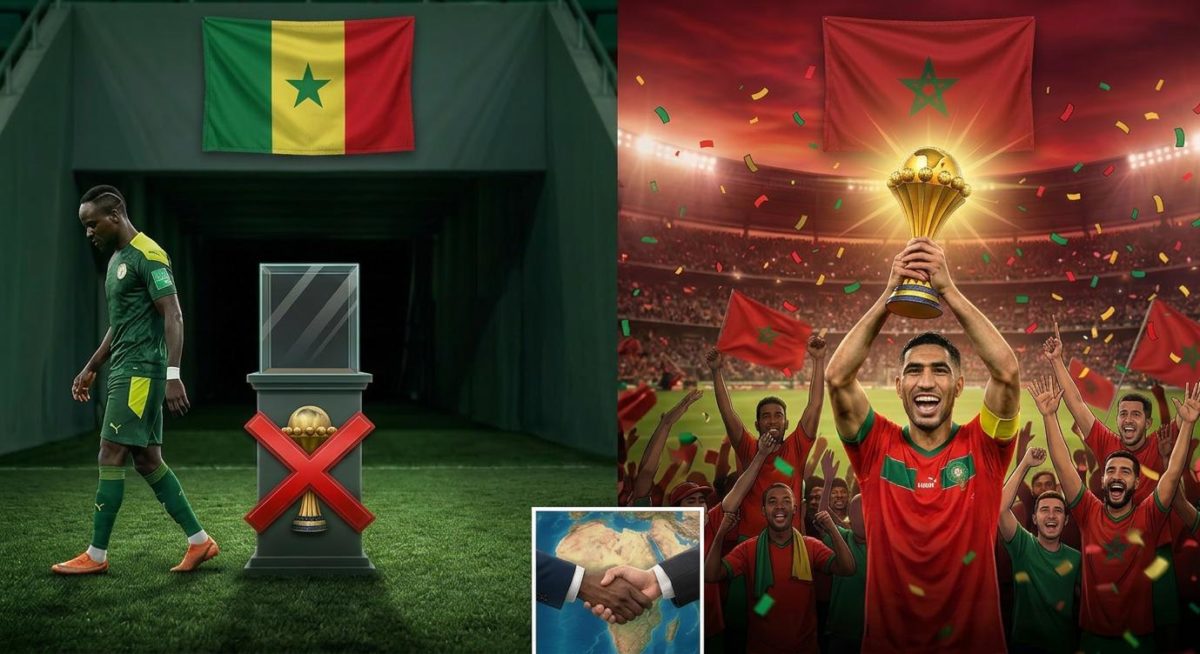
The most inflammatory decision in modern-day football history has happened, as Morocco was handed the AFCON (African Cup of Nations) trophy exactly 58 days after losing the final, courtesy of Pape Gueye’s dagger in the 94th minute of extra time.
In reality, this is one of the best editions of the AFCON in years, or actually, since it first emerged in 1957.
This AFCON had a good fan experience and several infrastructural facilitations, like the stadiums that Morocco spent on and the quality fan experience and the expanded media coverage in key European markets, which saw a remarkable increase in countries like France (3.4M views) and the UK (1.7M views), according to The Independent.
The outlet also reported that CAF saw a significant increase in revenue, with $192.6 million and $114 million compared to $105.6 million and $72 million in the previous editions of Africa’s biggest tournament.
However, the tournament was filled with on-field controversy, such as the ball boys incident, ticketing issues, and bogus refereeing in several games involving the host nation, Morocco, and it was a recurring theme that shaped the final of the competition.
The latest controversy is the decision to deprive the 2025 AFCON champions, Senegal, of the trophy despite their valid and clear win.
It takes us to why exactly the initial champion, Senegal, was stripped of the AFCON trophy after winning it two months prior.
Appeal after the final
After the final of the AFCON, in the press conference that followed, former Morocco head coach Walid Regragui called Senegal’s AFCON final a walk-off, saying, “The image we’ve given of Africa is shameful,” after which CAF (Confederation of African Football) labelled the conduct of the Senegalese players in the final as “unacceptable” and “inappropriate”.
The Moroccan Football Federation released a statement stating that it will take legal action against CAF and FIFA, as the walk-off by the Senegalese players, which lasted 15 minutes, had a significant impact on the players’ performance and ultimately shaped the result of the entire game.
Verdicts!
On January 28th, 2026, the CAF disciplinary board released an official statement regarding the punishments for both Morocco and Senegal for their conduct in the final, which also included fines for the Moroccan football federation and players like Achraf Hakimi and Ismaël Saibari, who were both suspended for two and three matches, respectively, and Saibari was also fined $100,000.
The Fédération Royale Marocaine de Football (FRMF) imposed $315,000 in fines for unsporting conduct, including the use of lasers by supporters and inappropriate behaviour by the ball boys.
On the other hand, the Fédération Sénégalaise de Football (FSF) accumulated more fines, rising to $615,000, which included improper conduct by its supporters, players, and technical staff, and several players had already been cautioned. Players like Baroy Ndiaye and Ismaila Sarr were suspended for improper conduct and unsporting behaviour, and also racked up fines for behaviour towards the referee. Head coach Papa Bouna Thiaw was given a 5-touchline ban and fined $100,000.
After CAF had addressed all punishments and fines to both teams in the statement, the CAF disciplinary board now addresses Morocco’s appeal regarding the AFCON final for violations of Articles 84 and 82.
The disciplinary board reached a decision and rejected the protest by the Fédération Royale Marocaine de Football (FRMF) against the violations by the Fédération Sénégalaise de Football (FSF).
Is Morocco the champion of Africa?
The CAF (Confederation of African Football) appeal board released a statement stating that in the application of both Article 84 and Article 82, the Senegalese players were deemed to have forfeited the match when they had left the pitch during the 15-minute “walk-off” and will now resort to a 3:0 defeat.
The appeal board also stated in its statement that the decision of the disciplinary board is now “set aside”.
The appeal board also reduced the match ban for Morocco’s Ismaël Saibari from two to one match ban and also discarded the $100,000 fine as well as the ball boy appeal incident, which is partially upheld, and the fine given to the Moroccan federation has been reduced to $50,000, and there was a reduction in the fine given to the Fédération Royale Marocaine de Football (FRMF) for the laser incident.
My Thoughts…
Personally, this is a very ludicrous decision from the CAF, as Morocco had already had their appeal rejected by the disciplinary board.
What I think CAF also got wrong was the grounds for the decision to strip Senegal of the AFCON trophy.
According to the regulations of the AFCON, chapter 19 and article 43.7 state the following: The decisions taken by the referee on the ground during the match on matters of fact shall not be subject to protests in any case, and also, IFAB Law 5 about referees states: The decisions of the referee regarding facts connected with play, including whether or not a goal is scored and the result of the match, are final. The decisions of the referee and all other match officials must always be respected.
From this, it is clear that the referee, Jean-Jacques Ndala, chose to continue the game when the Senegalese players returned to the pitch, as they were ready to resume. The referee’s decision in this context is clearly undermined.
There was a similar incident in 2019, when CAS (Court of Arbitration for Sport) became involved in the match between Wydad Casablanca and Esperance, in which the Wydad Casablanca players walked off the pitch in protest of VAR decisions and refused to continue the game.
Esperance was initially declared the winner as Casablanca had forfeited the game, but CAF called for a replay, and when Esperance took the issue to the CAS (Court of Arbitration for Sport), Esperance was eventually declared champion. Maybe a similar pattern might happen again.
At the same time, it’s not as easy as you think. Why is that? because it depends on how Senegal’s case is being presented to CAS. The Court of Arbitration for Sport usually rules in favour of matters or issues based on bias, fraud, and corruption, and might not rule in favour of Senegal if it adopts the “rules of the game” approach (Moulis Legal).
Worldwide Reaction
The Fédération Royale Marocaine de Football (FRMF) released its own statement as well, stating that it “wanted to respect the rules and show clarity”.
Whilst the Fédération Sénégalaise de Football (FSF) immediately released a statement labelling it as a “discrediting of the AFCON competition” and will immediately be appealing to the CAS. Abdoulaye Seydou Sow, the Secretary General of SFF, told local journalists that “the judge had come to carry out orders”, according to TalkSport.
Patrice Motsepe, the president of the Confederation of African Football, had this to say about the ongoing fiasco on the CAF’s official media website.
“The CAF disciplinary board took one decision. The CAF appeals board took a totally different position. And I’m told that Senegal is going to appeal, which is very important,” Motsepe said in a video published on the CAF website. “We will adhere to and respect the decision that’s taken at the highest level.”
Several Senegalese fans called the whole fiasco “a disgrace for Africa,” as France24 labelled it.
The same media outlet also reported that Moroccan fans in Rabat seem thrilled with the result, as one fan had claimed, “Everyone is happy with this outcome”, and “the cup returns to its rightful home”, and another had claimed, “Justice has been served.”
Conclusion
AFCON initially took a big step in the early stages of the competition, with improvements to the fan experience, infrastructure, and amenities.
However, fast forward to the latter stages of the competition, and it had started to prove people like Jamie Carragher right with his infamous statement about the competition.
AFCON is losing its credibility in front of the whole world, as it’s the first time something like this has happened in modern-day football, and it just happened to be at the AFCON. It makes me wonder whether the AFCON will ever truly recover from this.