

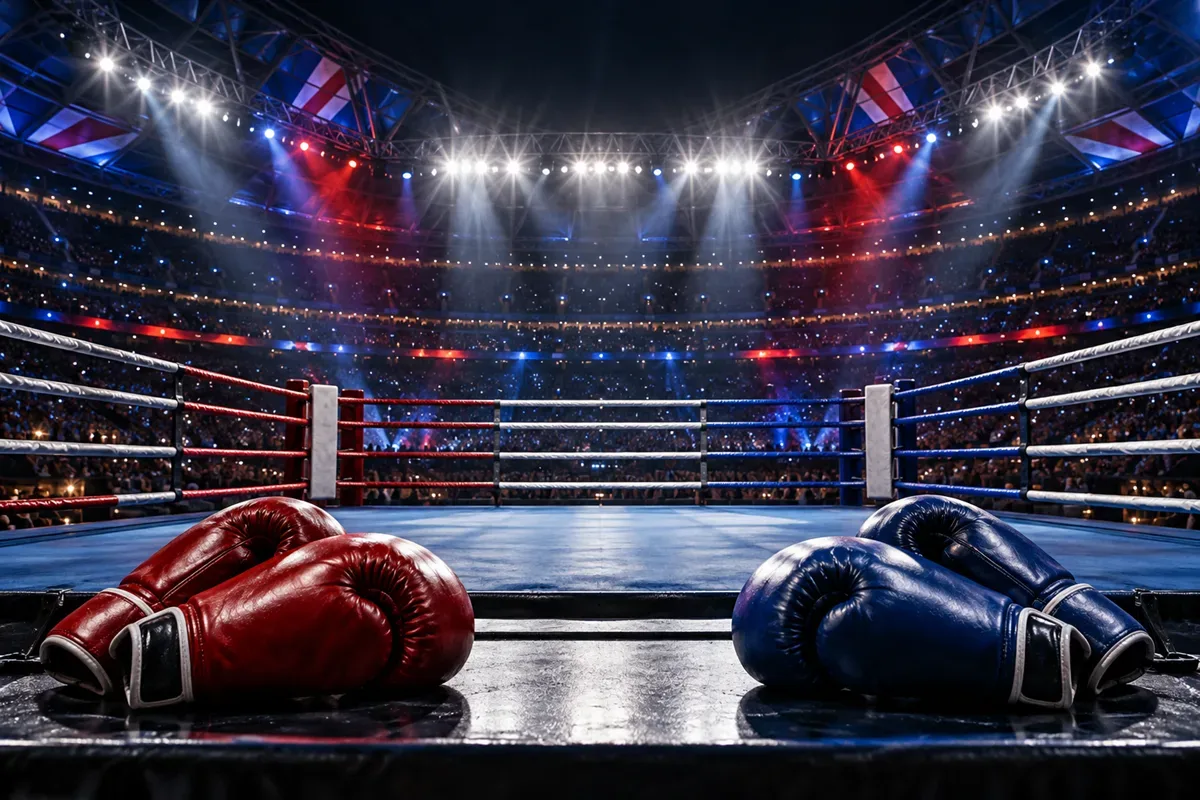
Tyson Fury and Anthony Joshua’s long-awaited heavyweight showdown has sold out within an hour of tickets going on sale, underlining the extraordinary demand for their first professional meeting.
The two former world heavyweight champions will face each other at Cardiff’s Principality Stadium on Friday, 11 December 2026, with Netflix broadcasting the contest worldwide.
Around 80,000 tickets went on sale at midday on Friday, 9 October. Prices ranged from £88.50 to £13,128, including booking fees. More than 500,000 supporters reportedly joined online queues within minutes.
The rapid sell-out, reported by Reuters and British media, provides an early indication of the public interest surrounding a fight that has taken years to arrange.
However, one significant detail remains unresolved. Organisers want the fighters to begin their ring walks at approximately 1 am on Saturday, 12 December, but the proposed late-night schedule still requires local authority approval.
Fury vs Joshua fight date, venue and UK start time
The heavyweight contest will headline an event at the Principality Stadium, bringing two of British boxing’s most recognisable fighters together for the first time as professionals.
The confirmed arrangements are:
- Fight: Tyson Fury vs Anthony Joshua
- Event date: Friday, 11 December 2026
- Venue: Principality Stadium, Cardiff, Wales
- Expected ring walks: Approximately 1 am GMT, Saturday, 12 December
- Broadcast: Netflix
- Expected attendance: Around 80,000
- Fight status: Officially announced, with the proposed late-night schedule awaiting approval
The main-event timing is unusual for a major British boxing occasion.
According to Reuters’ report on the application submitted to Cardiff Council, organisers have requested permission for the stadium to remain open until 3.30 am
The proposal also seeks extended permission for live music and alcohol sales until 3 am
Under the submitted arrangements, the stadium roof would remain closed. Ticket holders would need to enter by 11.30 pm on 11 December, with no late admissions.
Cardiff Council confirmed on 8 October that the application had not yet received approval.
The distinction matters for supporters arranging accommodation, transport or travel home. Although the fight date and venue are confirmed, the expected ring-walk time should not be treated as final.
Embed from Getty ImagesTickets sell out as demand exceeds available seats
The initial public sale demonstrated the scale of interest in the all-British contest.
British media reported that tickets disappeared within an hour, despite the stadium offering approximately 80,000 places.
The lowest advertised ticket price was £88.50. At the other end of the standard ticket range, some seats cost £13,128.
The substantial price difference reflects the varying seating options available for one of the year’s highest-profile boxing events.
For supporters unable to secure tickets, the global Netflix broadcast provides an alternative way to watch the contest.
The event also represents a major occasion for Cardiff, which previously hosted Joshua’s heavyweight victories over Carlos Takam in 2017 and Joseph Parker in 2018.
Joshua’s return to the Welsh capital now carries greater significance. Rather than defending a collection of heavyweight belts. He will face the British rival whose name has accompanied his career for much of the past decade.
Why Fury and Joshua are finally fighting
A professional contest between Fury and Joshua has been discussed for years.
Both men became world heavyweight champions during an era when British fighters occupied a prominent position in the division.
Joshua won Olympic super-heavyweight gold at London 2012 before becoming a unified professional world champion.
Fury defeated Wladimir Klitschko in November 2015 to capture multiple heavyweight titles. He later reclaimed championship status through his victories over Deontay Wilder.
Their respective achievements made a meeting increasingly attractive, but repeated negotiations failed to produce a fight.
Plans for a potential undisputed championship contest in 2021 collapsed after an arbitration ruling required Fury to fulfil his contractual obligations to Wilder.
Other opportunities also passed without agreement.
The latest negotiations involved disagreements over the venue. New York’s Madison Square Garden emerged as a potential location, while Joshua and his representatives pressed for the contest to take place in Britain.
The eventual decision to stage the fight in Cardiff satisfied the demand for a domestic venue while offering greater flexibility over the proposed late-night schedule.
Saudi boxing figure Turki Alalshikh announced the agreement on 24 September.
Fury and Joshua subsequently appeared together at a London press conference on 30 September, where they faced each other before photographers and supporters.
Despite their long-running rivalry, the fighters exchanged smiles and showed respect during the event.
The meeting marked a significant change from previous years, when discussions about their rivalry frequently centred on failed negotiations rather than preparations for an actual fight.
Both heavyweights enter with something to prove
Fury, 38, and Joshua, 36, have already experienced the highest levels of heavyweight boxing.
However, neither enters this contest as the dominant champion of the division.
Fury holds a professional record of 36 wins, two defeats and one draw, including 25 knockout victories.
Joshua has recorded 30 wins and four defeats, with 27 victories by knockout.
Both men have lost twice to Oleksandr Usyk, whose victories changed the balance of power in the heavyweight division.
Fury suffered consecutive points defeats against Usyk in May and December 2024.
Joshua previously lost his unified titles to the Ukrainian in September 2021 before losing their rematch in August 2022.
Those results add another dimension to the December contest.
Rather than determining who becomes the undisputed heavyweight champion, the meeting offers both fighters an opportunity to secure a major victory over a longstanding domestic rival.
Fury’s route back to the ring
Fury announced his retirement in January 2025 following his second defeat against Usyk.
He subsequently returned to professional boxing in 2026.
In April, he defeated Arslanbek Makhmudov by unanimous decision at Tottenham Hotspur Stadium.
He followed that victory with a seventh-round stoppage of Mariusz Wach in Thailand in July.
Those performances helped restore competitive momentum, although neither opponent presented the same technical and physical challenges that Joshua look likely to offer.
World in Sport examined Fury’s comeback, championship achievements and changing fighting style in its Tyson Fury career profile.
His ability to control distance, change angles and disrupt an opponent’s rhythm remains central to his approach.
Against Joshua, those qualities could prove particularly important.
Joshua’s return following setbacks
Joshua has also worked to rebuild his position after several damaging defeats.
Daniel Dubois stopped him in the fifth round at Wembley Stadium in September 2024, ending Joshua’s attempt to become a three-time heavyweight world champion.
Joshua returned in December 2025 and knocked out Jake Paul before facing Kristian Prenga in July 2026.
His victory over Prenga was not straightforward.
Joshua suffered two first-round knockdowns before recovering to secure a second-round stoppage.
The result highlighted both his vulnerability when caught cleanly and the finishing power that has defined much of his professional career.
World in Sport covered those developments in its review of Fury and Joshua’s July comeback victories.
Joshua’s ability to maintain his balance, control exchanges and defend against counter-punches will be important when he faces Fury.
Embed from Getty ImagesFury vs Joshua: How their fighting styles compare
Beyond the commercial interest, the contest presents an intriguing tactical matchup.
Fury has traditionally relied on movement, timing and adaptability. His height and reach allow him to manage distance, while his experience helps him adjust his approach during fights.
He can box behind a jab or close the distance to impose his size in the clinch.
Joshua takes a more structured approach to his offence.
He operates from an orthodox stance, using his jab to establish range before delivering combinations built around his straight right hand and uppercut.
His power makes him dangerous when he establishes a stable punching position.
However, opponents have exposed weaknesses in his defence, particularly when he retreats directly backwards or struggles to regain his balance after an exchange.
Fury’s task will be to disrupt Joshua’s timing without allowing him sustained opportunities to land clean power punches.
Joshua, meanwhile, must prevent Fury from controlling the tempo through movement and clinching.
He will also need to attack with enough precision to avoid leaving openings for counters.
Neither fighter can rely entirely on previous achievements. Their recent performances suggest that maintaining concentration and controlling the distance could be decisive.
The tactical contest may prove very different from the aggressive exchanges that have characterised some of their most memorable victories.
No automatic rematch agreed
Another important feature of the contest is the absence of a contractual rematch clause.
Fury’s manager, Spencer Brown, confirmed to Sky Sports on 5 October that the agreement covers one fight.
That means neither boxer has an automatic contractual right to demand an immediate second meeting after the December result.
The arrangement differs from several high-profile heavyweight championship contests in which rematch clauses have shaped the division’s schedule.
It does not prevent Fury and Joshua from negotiating another fight in the future.
However, any second contest would require a fresh agreement rather than following automatically from the existing contract.
The position also increases the significance of their first meeting.
Both men have previously discussed retirement, while Fury has expressed interest in another contest against Usyk.
Neither possibility should be treated as a confirmed next step.
For now, their immediate professional focus remains the December showdown.
Joshua reunites with Ben Davison for the fight
Joshua’s preparations have attracted additional attention because of his coaching arrangements.
Ben Davison, who previously worked with Fury, is back in Joshua’s corner for the contest.
Davison helped guide Fury during an earlier period of his comeback, including his return to elite heavyweight competition after a lengthy absence.
His knowledge of Fury’s training methods and technical approach has therefore become a talking point.
Joshua has also spoken with Peter Fury, Tyson’s uncle and former trainer.
Peter Fury played an important role in preparing Tyson for his 2015 victory over Klitschko.
However, those connections do not establish that Joshua possesses a decisive tactical advantage.
Fury has continued to develop his style under different trainers, while fighters regularly adjust their preparation between major contests.
Joshua’s coaching arrangements will ultimately matter through the decisions he makes inside the ring.
Image Embed: Anthony Joshua training with Ben Davison, showing their preparations for the December heavyweight meeting with Tyson Fury.
How to watch Fury vs Joshua on Netflix
Netflix will broadcast Fury against Joshua live worldwide.
The streaming service has confirmed the fight through its official Fury vs Joshua event guide.
The contest will be available to Netflix subscribers, with no separate pay-per-view purchase required.
For British viewers, the proposed 1 am ring walks would place the main event in the early hours of Saturday, 12 December.
That schedule remains subject to the outstanding Cardiff Council application.
The full running order and confirmed timings for supporting bouts should be checked closer to fight night.
What is at stake in Cardiff?
The December meeting carries significance beyond the result of a single heavyweight contest.
Fury and Joshua have collectively shaped much of British heavyweight boxing over the past decade.
Both have headlined major stadium events, won multiple world championship fights and attracted substantial international audiences.
Yet their professional careers have followed separate paths.
Fury’s victories over Klitschko and Wilder established his championship credentials. Joshua’s Olympic success and subsequent professional title reign made him one of the leading commercial figures in the sport.
Their defeats to Usyk and other setbacks have since changed the circumstances surrounding their rivalry.
The timing has prompted debate over whether the contest should have taken place earlier, when both fighters held world championship belts.
Nevertheless, December will provide the first direct professional comparison between them.
The result will not settle every historical argument about their respective careers. It will, however, answer the central sporting question that years of negotiations left unresolved: what happens when Fury and Joshua finally share a ring?
With tickets reportedly selling out within an hour, attention now turns to Cardiff Council’s decision on the late-night schedule and the final stages of the fighters’ preparations.
For the thousands of supporters who have waited years for the matchup. The remaining uncertainty concerns the precise start time rather than the identity of the fighters or the confirmed venue.


Have your say
Join the debate
Share your view with other World in Sport readers below.