















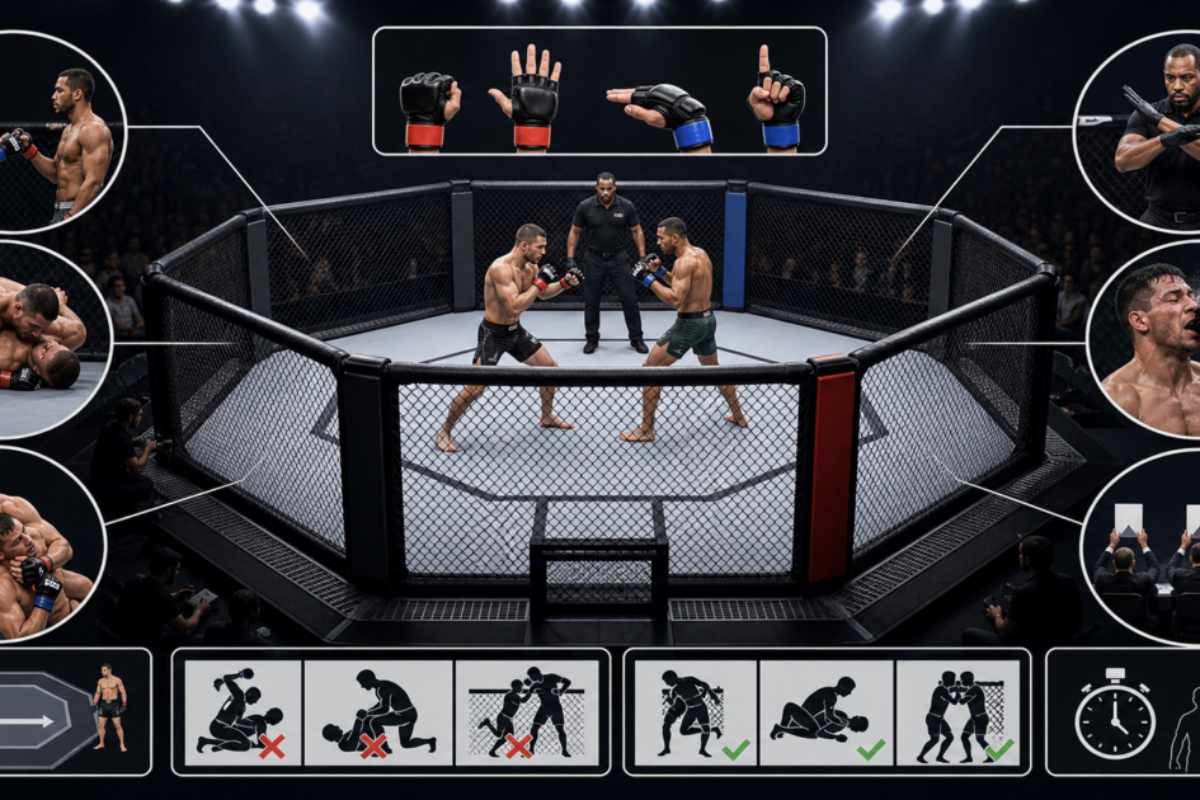
UFC fights follow the Unified Rules of MMA, with rounds, judges, referees, weight classes and defined fouls. Most bouts are three five-minute rounds; title fights and many main events are five rounds; and wins can come by knockout, submission, decision, disqualification, or no contest.
Scoring prioritises effective striking and grappling, then aggression and control if needed. The guide also explains illegal moves, restrictions on grounded fighters, equipment, the referee’s role, and how UFC rules differ from boxing rules.
UFC can look chaotic to a new fan. Two fighters meet inside the Octagon. They can punch, kick, wrestle, grapple and chase submissions. Yet the sport is not a free-for-all. Modern UFC fights follow a clear set of rules, with rounds, judges, referees, fouls, weight classes and strict ways to win.
This guide to UFC rules explains the basics in plain English. It covers how long fights last, how scoring works, what fighters can and cannot do, and why a bout can end by knockout, submission, decision, disqualification or no contest.
For more simple explainers, visit the Sports Guides hub.
The UFC uses mixed martial arts rules based on the Unified Rules of MMA. These are overseen by athletic commissions, not just the promotion itself. The Association of Boxing Commissions’ current rules state that MMA bouts are judged by at least three judges, use the 10-point must system, and score effective striking and grappling first.
What Are UFC Rules?
UFC rules govern professional mixed martial arts fights in the UFC. They decide what techniques are legal, how long fights last, how judges score rounds, and when a referee should stop the contest.
A fighter can win with striking, grappling, submissions, pressure, control, or a mix of all of them. However, only an effective offence matters most. A fighter does not win a round just by moving backwards, blocking shots, or holding a position without doing damage or threatening a finish.
That is why UFC scoring can sometimes divide fans. One viewer may value takedowns. Another may focus on strikes. Judges are told to score effective striking and effective grappling first. If those are even, they then look at effective aggression. If that is still even, they consider control of the fighting area.
| Rule Area | Simple Explanation |
|---|---|
| Rounds | Most UFC fights have three five-minute rounds. Title fights and most main events have five five-minute rounds. |
| Scoring | Judges use the 10-point must system. The round winner usually gets 10 points. |
| Winning | A fight can end by knockout, TKO, submission, decision, disqualification or no contest. |
| Fouls | Illegal moves include eye gouging, groin attacks, headbutts, strikes to the spine or back of the head, and knees or kicks to the head of a grounded opponent. |
| Weight classes | Fighters compete within set weight limits to keep bouts fair and safer. |
How Long Is a UFC Fight?
Most UFC fights are scheduled for three rounds. Each round lasts five minutes, with a one-minute rest between rounds. If the fight reaches the final bell, the judges decide the winner.
Title fights are scheduled for five rounds. UFC main events are also usually five rounds, even when no belt is on the line. That is why fans often call rounds four and five the “championship rounds”.
A three-round fight can last up to 15 minutes of fighting time. A five-round fight can last up to 25 minutes. The real broadcast slot is longer because of walkouts, introductions, pauses, reviews, corner time and official decisions.
The Unified Rules state that professional MMA rounds are five minutes long, with one-minute rest periods, and no bout can exceed five rounds or 25 minutes of fighting time.
How Do You Win a UFC Fight?
A UFC fight can end in several ways. The most common are knockout, technical knockout, submission and judges’ decision.
A knockout happens when a legal strike leaves a fighter unable to continue. A technical knockout, or TKO, happens when the referee, doctor or corner stops the fight because a fighter cannot safely defend or continue.
A submission happens when a fighter taps, verbally submits, screams in pain during a submission, or is rendered unconscious by a legal choke. The Unified Rules also list technical submission as a result when a legal submission causes unconsciousness or a broken or dislocated bone or joint.
| Result | What It Means |
|---|---|
| KO | A fighter is knocked out by legal strikes and cannot continue. |
| TKO | The referee, doctor or corner stops the fight because a fighter is not safely defending or cannot continue. |
| Submission | A fighter taps, verbally gives up, or is forced to stop because of a legal submission. |
| Decision | The fight reaches the final bell and the judges score the bout. |
| Disqualification | A fighter loses because of a serious intentional foul or repeated fouls. |
| No Contest | The fight ends without a winner, often due to an accidental foul before enough rounds are completed. |
How UFC Scoring Works
UFC judges score each round using the 10-point must system. In most rounds, the winner gets 10 points, and the loser gets 9. A closer round is usually 10-9. A dominant round can be 10-8. A rare, one-sided round can be 10-7.
Judges do not simply count strikes or takedowns. They look at the effect of the action. A clean punch that hurts a fighter may matter more than several light strikes. A takedown with damage or submission danger may matter more than a takedown where nothing happens afterwards.
The scoring order matters:
First, judges assess effective striking and effective grappling. This is the main scoring layer.
Next, they assess effective aggression. This only matters if the striking and grappling are even.
Finally, they assess control of the fighting area. This only matters if the first two layers are still even.
That means walking forward is not enough on its own. A fighter who pressures but gets hit cleanly may still lose the round. A fighter who lands fewer strikes but causes more damage may win it.
The latest ABC rules explain that effective striking is based on the impact of legal strikes, while effective grappling includes successful takedowns, submission attempts, advantageous positions and reversals.
What Is a 10-8 Round in UFC?
A 10-8 round is a round won by a large margin. It often includes clear impact, dominance and duration.
Impact means the winning fighter has hurt, damaged or clearly affected the opponent. Dominance means one fighter controls the offence while the other is mostly defending. Duration means the winner holds that advantage for a meaningful part of the round.
This is why a fighter can win a 10-8 round without scoring a knockdown. A long spell of ground-and-pound, repeated submission threats, heavy strikes, or sustained control with real offence can all create a 10-8.
A 10-8 is important because it can change a fight. For example, if a fighter loses two close rounds 10-9 but wins one round 10-8, the score can become level on one judge’s card.
UFC Fouls Explained
UFC fighters can use many techniques from boxing, kickboxing, wrestling, jiu-jitsu, judo and other martial arts. However, some moves are illegal.
Common UFC fouls include headbutts, eye gouging, biting, fish hooking, hair pulling, groin attacks, small joint manipulation, strikes to the spine or back of the head, throat strikes, grabbing the trachea, and holding an opponent’s gloves or shorts.
Fighters also cannot knee or kick the head of a grounded opponent. Under the current ABC wording, a fighter is grounded when any part of the body other than the hands or feet is touching the canvas. The rules list kneeing or kicking a grounded opponent’s head as a foul.
| Foul | Why It Is Illegal |
|---|---|
| Eye gouging | It can cause serious eye damage and is not a legal strike. |
| Groin attack | Any strike, grab, pinch or twist to the groin is illegal. |
| Headbutt | The head cannot be used as a striking weapon. |
| Back-of-head strike | Strikes to the spine or back of the head are dangerous and illegal. |
| Fence grab | It can stop takedowns or change position unfairly. |
| Knee or kick to grounded head | A grounded fighter cannot be kneed or kicked in the head. |
If a foul happens, the referee can pause the fight, check the injured fighter, warn the offender, deduct points, restart the position, call in the doctor, or stop the fight. For eye pokes or groin fouls, the fouled fighter may get up to five minutes to recover if they can continue.
What Happens After an Illegal Strike?
The result depends on whether the foul was intentional or accidental, how serious the injury is, and how much of the fight has already taken place.
If an accidental foul ends the fight before enough time has been completed to use the scorecards, it may be declared a no contest.
If enough of the scheduled fight has been completed, the judges’ scorecards may decide the result by technical decision.
That is why fans sometimes hear unusual results after fouls. A fight may not simply restart if the injured fighter cannot continue. The referee, doctor and commission rules all matter.
UFC Weight Classes Explained
UFC weight classes keep fighters within set limits. This helps make bouts fairer and reduces extreme size gaps.
Fighters weigh in before the event. In non-title fights, there is often a one-pound allowance if the bout contract or commission rules allow it. In title fights, fighters must make the exact championship limit.
The UFC’s own weight-class guide lists the standard divisions from strawweight at 115lb through heavyweight at 265lb.
| Division | Limit | Approx. KG |
|---|---|---|
| Strawweight | 115 lb | 52.2 kg |
| Flyweight | 125 lb | 56.7 kg |
| Bantamweight | 135 lb | 61.2 kg |
| Featherweight | 145 lb | 65.8 kg |
| Lightweight | 155 lb | 70.3 kg |
| Welterweight | 170 lb | 77.1 kg |
| Middleweight | 185 lb | 83.9 kg |
| Light heavyweight | 205 lb | 93.0 kg |
| Heavyweight | 265 lb | 120.2 kg |
Not every division is active in the same way for men and women. The UFC has long used eight main men’s divisions from flyweight to heavyweight. Women’s UFC competition has mainly centred on strawweight, flyweight and bantamweight, while women’s featherweight has been used far less often and has not had the same regular depth as those divisions.
What Is a Grounded Fighter?

The grounded fighter rule matters because it changes what strikes are legal.
If a fighter is grounded, their opponent cannot legally knee or kick them in the head. This often comes up during takedowns, scrambles and cage wrestling.
Fans may see a fighter place a hand on the mat to try to make themselves “grounded”. However, modern rule wording is stricter than older versions in many places. Local commission rules can still matter, so a legal position in one place may be treated differently in another if the commission has not adopted the latest updates.
This is one reason UFC rules can seem confusing. The UFC promotes the fight, but athletic commissions regulate events. Most fans can follow the simple version: do not knee or kick the head of a grounded opponent.
Are Elbows Legal in UFC?
Yes, elbows are legal in UFC, but the target and situation matter.
Elbows to legal areas of the head and body are allowed. However, strikes to the back of the head, spine, throat or other illegal targets remain fouls. The old “12-to-6 elbow” ban was removed from the updated Unified Rules, but fans should remember that athletic commissions can vary in how and when they adopt rule changes.
Some athletic commissions may adopt rule changes at different times, which is why location can still matter.
So the safe answer is this: elbows are legal when thrown to legal targets, but the referee and commission rules decide the details on fight night.
What Can Fighters Wear?
UFC fighters wear approved shorts, gloves and a mouthguard. They do not wear shoes. Male fighters also wear approved groin protection. Female fighters wear approved bottom covering and a short-sleeved or sleeveless form-fitting rash guard and/or sports bra.
Gloves are open-fingered, which allows striking and grappling. This is one of the key differences between UFC and boxing. A fighter can punch, then clinch, wrestle, lock a submission, or strike from top position on the ground.
Hand wraps are also controlled. The ABC rules set limits on gauze and tape, and wraps are checked by officials before gloves go on.
For a useful comparison with another combat sport, see our Boxing Rules Explained guide.
What Is the Role of the Referee?
The referee is inside the Octagon to protect fighters and enforce the rules. They can stop the fight, warn fighters, deduct points, separate fighters, restart the action, pause time, call the doctor, or end the bout.
A good referee does not just wait for a knockout. They watch whether a fighter is intelligently defending. If a fighter is taking damage and cannot protect themselves, the referee can stop the contest.
This can frustrate fans when a fighter protests a stoppage. Yet the rule is based on safety. Fighters do not need to be unconscious for a TKO. If they cannot defend, the referee can step in.
UFC Rules vs Boxing Rules
UFC and boxing both use judges, rounds, weight classes and fouls. But the sports are very different.
Boxing only allows punches with gloved fists. UFC allows legal punches, kicks, knees, elbows, takedowns, clinch work, ground control and submissions. That makes scoring more complex.
A boxer can win by clean punching and ring craft. A UFC fighter can win by damage on the feet, wrestling control with offence, submission attempts, reversals, ground strikes, or a mix of all phases.
That is why UFC judging starts with effective striking and grappling. The sport rewards the fighter who uses their legal skills to hurt, threaten, control or finish the opponent.
For a different rules guide, you can also read NBA Rules Explained.
Why UFC Rules Matter for New Fans
Once you understand the rules, UFC becomes much easier to watch.
You can see why a fighter won a close round. You can understand why a referee paused the action. You can spot why a takedown did or did not matter. You can also judge whether a fighter is winning because of real offence or just looking busy.
The key is to focus on effect. Who landed the cleaner, harder legal strikes? Who created stronger submission threats? Who used grappling to damage, advance or threaten? Who was closer to finishing the fight?
That is what judges are meant to value first.
UFC Rules Explained: Quick FAQ
How many rounds are in a UFC fight?
Most UFC fights have three five-minute rounds. Title fights and most main events have five five-minute rounds.
How is a UFC fight scored?
Three judges usually score each round using the 10-point must system. The winner of a round normally gets 10 points, while the loser usually gets 9 or fewer.
Can UFC fighters kick a grounded opponent?
They can kick the body or legs in legal ways, but they cannot knee or kick the head of a grounded opponent.
Are submissions allowed in UFC?
Yes. Fighters can win by tap out, verbal submission, technical submission or referee stoppage from a submission.
Can a UFC fight end in a draw?
Yes. A fight can end in a draw if the judges’ scorecards are level. The majority draws, and split draws are also possible.
What happens if a fighter misses weight?
The bout may be cancelled, changed to a catchweight, or continue with penalties, depending on commission approval and the opponent’s agreement. In many cases, a percentage of the fighter’s purse can go to the opponent. Any money figures should be shown in pounds first, with dollars in brackets, if used in a specific news report.
Final Word on UFC Rules
UFC rules are designed to balance excitement, fairness and fighter safety. The sport allows far more techniques than boxing, but it still has clear limits. Fighters must compete inside weight classes, follow foul rules, defend themselves, and win rounds through effective offence.
For new fans, the easiest way to watch is simple. Look for damage, strong grappling, submission danger, clean strikes and real attempts to finish. That is where most UFC fights are won.


Have your say
Join the debate
Share your view with other World in Sport readers below.