







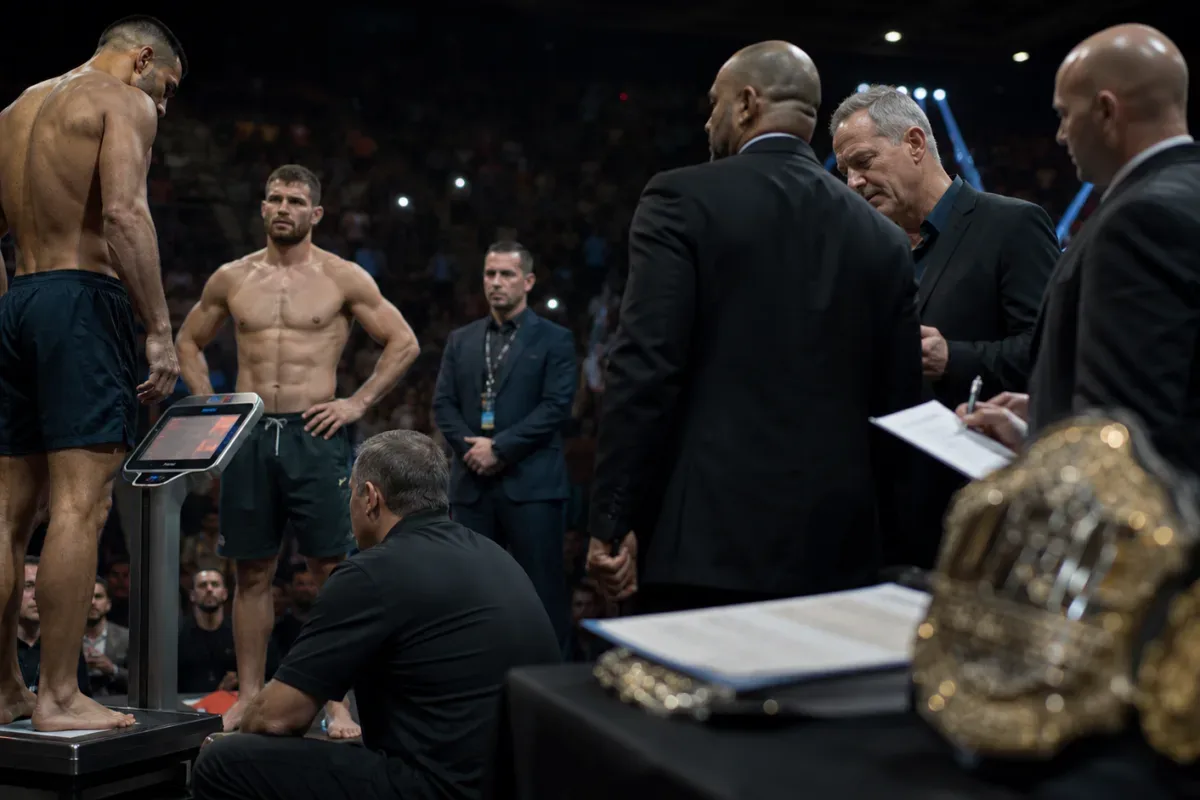
UFC fighters who miss weight do not automatically lose or leave the card. Non-title bouts usually allow one extra pound, while championship fights have no one-pound allowance and require fighters to weigh at or below the championship limit. Depending on the commission, contract and opponent’s agreement, the bout may proceed at a catchweight, involve a purse forfeiture or be cancelled.
A missed weight can also affect title eligibility: challengers generally cannot win the belt, and defending champions risk losing championship status. Rules and penalties vary by jurisdiction, and opponents or regulators can reject a fight if the weight difference creates safety concerns.
A UFC fighter who misses weight does not automatically lose the fight or get removed from the card. What happens next depends on how much weight they missed by, whether the bout is for a title, the rules of the athletic commission and whether the opponent agrees to continue.
For a standard non-title UFC bout, fighters usually receive a one-pound allowance above the divisional limit. A lightweight contest can therefore normally include a fighter weighing 156lb, while a welterweight can weigh 171lb.
Championship bouts are different. There is no one-pound allowance, so fighters must weigh at or below the division’s championship limit.
If somebody misses weight, the fight may continue at a catchweight. The fighter who came in heavy may also surrender part of their purse to their opponent. However, there is no single UFC rule that automatically sets the same fine for every weight miss.
Title fights carry greater consequences. A fighter who fails to make championship weight cannot normally win the title, while a defending champion who misses weight can lose their championship status.
The exact outcome can vary because the UFC promotes its events, while athletic commissions or other local regulators oversee the contests. That distinction is important when discussing UFC weight miss rules.
For a wider explanation of how UFC contests operate, including rounds, scoring, fouls and divisions, see World in Sport’s UFC rules guide.
What counts as missing weight in the UFC?
Every UFC bout has a contracted weight.
The promotion uses divisions including women’s strawweight at 115lb, flyweight at 125lb, bantamweight at 135lb, featherweight at 145lb, lightweight at 155lb, welterweight at 170lb, middleweight at 185lb, light heavyweight at 205lb and heavyweight at 265lb.
In most non-title UFC fights, the fighter can use a one-pound allowance.
That means these weights would normally be acceptable:
| Division | Championship limit | Typical non-title maximum |
|---|---|---|
| Women’s Strawweight | 115lb | 116lb |
| Flyweight | 125lb | 126lb |
| Bantamweight | 135lb | 136lb |
| Featherweight | 145lb | 146lb |
| Lightweight | 155lb | 156lb |
| Welterweight | 170lb | 171lb |
| Middleweight | 185lb | 186lb |
| Light heavyweight | 205lb | 206lb |
| Heavyweight | 265lb | 266lb |
The UFC’s official weight-class guidance confirms the one-pound allowance for non-title contests, while championship fighters must weigh at or below the division’s championship limit.
The allowance should not be treated as an absolute worldwide rule. The Association of Boxing Commissions has historically described the one-pound non-title allowance as something that should be provided for in the bout contract or regulations, while individual commissions can impose their own requirements.
Nevada, one of the UFC’s most frequently used jurisdictions, states that a fighter can generally weigh one pound above the contracted weight unless the bout is a championship contest requiring otherwise or the contract specifies a maximum weight.
Embed from Getty ImagesWhat happens when a UFC fighter misses weight?
There is no single automatic outcome.
Several things can happen after a fighter records a weight above the permitted limit.
The bout can continue at an agreed catchweight. The overweight fighter may surrender part of their purse. The opponent can decline to accept the revised fight, while regulators can also refuse to sanction the contest if they consider the weight difference unsafe.
In some circumstances, the fight is cancelled.
UFC itself lists the main possible outcomes as a purse forfeiture, a negotiated catchweight contest or cancellation.
The size of the miss matters, but it does not create a universal UFC formula. Being two pounds heavy does not automatically produce one penalty while being four pounds heavy produces another.
Jurisdiction, contractual terms and the circumstances of the fight all matter.
What is a catchweight fight?
A catchweight bout takes place at a weight outside the usual divisional limit or at another specifically agreed figure.
Catchweights can be arranged in advance. They can also become relevant after a fighter misses their contracted weight.
For example, suppose two fighters are scheduled for a non-title lightweight bout. One weighs 155.5lb and the other weighs 159lb.
The first fighter is within the usual 156lb non-title allowance. The second has missed lightweight.
If the opponent accepts the fight and the regulator approves it, the contest may still take place at a revised catchweight rather than being cancelled.
That does not mean the UFC fighter has somehow “made weight”. The official record can still show that they missed the contracted limit.
ABC guidance recognises that commissions may approve catchweight contests subject to their review and discretion. A regulator can still refuse to approve a contest if it does not consider the matchup fair, safe and competitive.
Can the opponent refuse a catchweight fight?
Yes.
A fighter who successfully makes the agreed weight does not have to ignore a significant weight miss simply because their opponent wants the contest to continue.
The parties may negotiate after the weigh-in. That can include a purse forfeiture and a revised weight agreement.
The athletic commission must still be satisfied that the contest can safely proceed.
That becomes particularly important when one fighter has missed by several pounds. Weight classes exist partly to restrict excessive size differences between competitors.
A UFC bout remaining on the card therefore does not mean the miss was permitted under the original contract. It means a revised arrangement was accepted and approved.
How much are UFC fighters fined for missing weight?
There is no universal percentage that applies to every UFC weight miss.
Fans often see 20 or 30 per cent quoted because both figures have appeared regularly in UFC weigh-in announcements.
For example, Kevin Borjas surrendered 20 per cent of his purse after weighing three pounds over the flyweight limit before a UFC Fight Night event in June 2026. UFC also announced a 30 per cent forfeiture when Jeremy Stephens weighed 160lb for a lightweight bout at UFC 328 in May 2026.
At UFC Perth in May 2026, Gerald Meerschaert weighed 190lb for a middleweight contest and forfeited 30 per cent of his purse to his opponent.
Earlier UFC events provide further examples of both 20 and 30 per cent deductions. That history shows why describing either figure as “the UFC fine” would be misleading.
The penalty depends on the circumstances and applicable regulatory or contractual arrangements.
Where a purse percentage is forfeited, UFC announcements commonly state that it goes to the opponent who made the required weight.
Embed from Getty ImagesDo fighters get another chance to make weight?
Sometimes.
UFC says fighters who miss on their first attempt may receive up to an additional hour to make the required limit, depending on the athletic commission and the amount of weight involved.
That should not be interpreted as a guaranteed UFC-wide second attempt.
Weigh-in procedures differ between jurisdictions.
The commission supervising the event controls the official scale and determines whether another attempt is permitted.
If a fighter cannot reach the required weight within the permitted period, they have officially missed weight.
Are UFC championship weigh-ins different?
Yes.
The one-pound allowance normally used for non-title contests does not apply to UFC championship fights. Fighters must weigh at or below the championship limit.
A lightweight title contender must weigh no more than 155lb. A reading of 155.5lb is therefore a miss, even though the same weight would be acceptable for a normal lightweight contest.
The same principle applies throughout the divisions.
A welterweight fighting for the championship cannot exceed 170lb, while a middleweight title fighter cannot exceed 185lb.
This distinction can dramatically change what happens to a championship.
What happens if a UFC champion misses weight?
A defending champion who fails to make championship weight risks losing the title.
Charles Oliveira provided one of the clearest modern examples before UFC 274 in May 2022.
Oliveira entered his lightweight title defence against Justin Gaethje as champion but weighed 155.5lb, half a pound above the championship limit.
UFC announced that Oliveira would remain champion until the start of the main event, at which point he would vacate the lightweight title. Gaethje, who had made championship weight, remained eligible to win it.
Oliveira could not retain the championship with a victory.
He subsequently won the bout, which left the lightweight title vacant rather than returning the belt to him. UFC had stated beforehand that an Oliveira victory would instead make him the leading contender for the vacant championship.
The Oliveira case also shows why the phrase “stripped at the weigh-in” can lack precision. UFC’s announcement said he remained champion until the main event began and would then vacate the championship.
What happens if the challenger misses weight?
If a challenger misses championship weight while the champion makes it, the challenger is generally no longer eligible to win the title.
The contest can still take place if the relevant parties and regulator agree.
The champion’s status can therefore remain protected even if the overweight challenger wins the fight.
An earlier variation happened when Deiveson Figueiredo faced Joseph Benavidez for the vacant UFC flyweight championship in 2020.
Figueiredo weighed 127.5lb, above the 125lb championship limit. Benavidez made weight.
The fight continued, but only Benavidez could win the vacant championship. Figueiredo won the contest, so the title remained vacant. UFC uses that fight in its own explanation of championship weight rules.
For more coverage of how contenders are positioned within divisions, World in Sport also explains the UFC ranking system.
What if both fighters miss championship weight?
If neither fighter makes the championship limit, the bout cannot operate as a normal championship fight with both competitors eligible for the belt.
What happens beyond that depends on the circumstances.
The UFC and supervising regulator would need to decide whether the bout can still proceed at a revised weight and what happens to the championship.
That is an area where it is particularly important not to turn past UFC decisions into an automatic universal rule.
Commission requirements, contractual arrangements and the status of the championship can all affect the outcome.
Can a fight be cancelled because of a weight miss?
Yes.
A bout is not guaranteed to continue simply because the fighters want to compete.
A commission can reject a contest if the weight difference creates a safety concern. The opponent can also decline a proposed catchweight arrangement.
The UFC itself identifies cancellation as one of the possible results of missing weight.
The likelihood of cancellation generally becomes more significant when the miss is substantial, although there is no single number that automatically cancels every UFC contest in every jurisdiction.
Different commissions can use different rules on acceptable weight differences.
Why do UFC fighters miss weight?
Making weight can involve reducing body mass in the weeks before a fight and cutting significant water weight close to the official weigh-in.
A fighter can miss because the planned cut goes wrong, illness intervenes, or their body stops responding as expected.
However, the reason for a miss does not change the recorded scale result.
Once the fighter is above the contractual limit, the commission and promotion must decide what happens next.
The process also explains why fighters generally weigh considerably more when they enter the Octagon than they did on the official scale. They have time to rehydrate and refuel between the weigh-in and the contest.
Weight management is therefore part of competitive preparation, not simply an administrative formality.
Does missing weight affect UFC rankings?
There is no automatic rankings deduction written into the UFC’s published rankings system for missing weight.
However, a miss can affect a fighter’s broader position within a division.
The UFC rankings are determined by a media voting panel rather than a mathematical league table. Matchmaking and future title opportunities also remain separate from the ranking vote.
A fighter who repeatedly struggles to make the division’s limit may eventually choose, or be encouraged, to compete at a higher weight.
For current fight coverage, previews and divisional developments, see the World in Sport UFC section.
Is missing weight the same as fighting at catchweight?
No.
This is one of the most commonly confused parts of MMA weigh-ins.
A planned catchweight contest is agreed before the weigh-in. Both fighters know the contracted limit when they prepare for the fight.
A catchweight created after somebody misses weight is different.
In that situation, the original contract had another limit. One fighter failed to meet it, and the parties subsequently agreed to let the contest continue under revised terms.
The final fight may therefore be described as a catchweight bout, but the overweight fighter still missed their original contracted weight.
Are ceremonial weigh-ins the official weigh-in?
No.
The televised or public weigh-in event that fans often see is usually ceremonial.
Official weights are recorded earlier during the commission-supervised weigh-in window. Those figures determine whether each competitor has made weight.
The later face-off exists primarily for spectators, broadcasters and promotion.
A fighter cannot correct an official weight miss by appearing lighter at the ceremonial weigh-in.
UFC’s official weigh-in reports publish the recorded weights before each event. A March 2026 UFC London card, for example, listed non-title featherweights at 146lb and welterweights at 171lb without those fighters missing weight, illustrating the standard non-title allowance.
Embed from Getty ImagesWhy athletic commission rules matter
It is common to talk about “UFC rules”, but UFC does not independently regulate every element of every event.
Where an athletic commission has jurisdiction, that regulator supervises matters including weigh-ins and whether a contest can be sanctioned.
The Unified Rules provide a common framework, but adoption and detailed procedures can differ between jurisdictions.
That is why two UFC weight misses that appear similar can produce different outcomes.
Location matters. The amount of weight matters. The contract matters. Whether the opponent accepts the revised contest matters.
The championship status of the fight matters as well.
Any explanation that says every UFC weight miss automatically produces the same fine or the same catchweight procedure oversimplifies the system.
Frequently asked questions
How much over the weight limit can a UFC fighter be?
In a standard non-title bout, UFC fighters normally have a one-pound allowance. A lightweight can therefore usually weigh 156lb and a welterweight 171lb. Championship fighters do not receive that allowance and must weigh at or below the divisional championship limit.
Does a UFC fighter automatically lose if they miss weight?
No. A weight miss happens before the fight and does not automatically count as a competitive defeat. The bout may continue at a revised catchweight if the opponent and regulator approve it.
Does the UFC always fine fighters 20 per cent for missing weight?
No. UFC records contain examples of both 20 and 30 per cent purse forfeitures, so there is no single percentage that should be described as an automatic UFC-wide fine.
Can a UFC title challenger win the belt after missing weight?
Normally not. A challenger who fails to make championship weight is not eligible to win the championship. UFC’s Figueiredo-Benavidez example demonstrates how the title can remain vacant even when the overweight fighter wins.
Can a UFC champion lose their belt for missing weight?
Yes. Charles Oliveira’s UFC 274 weight miss showed that a defending champion can lose championship status after weighing above the title limit.
Can an opponent refuse to fight someone who missed weight?
Yes. Continuing at a revised weight requires agreement and regulatory approval. A commission can also reject a bout if the weight disparity raises safety concerns.
Are UFC weight miss rules the same everywhere?
Not completely. Athletic commissions regulate UFC events in many jurisdictions, meaning weigh-in procedures and regulatory requirements can vary. Nevada, for example, expressly addresses its one-pound allowance in its commission guidance.


Have your say
Join the debate
Share your view with other World in Sport readers below.