
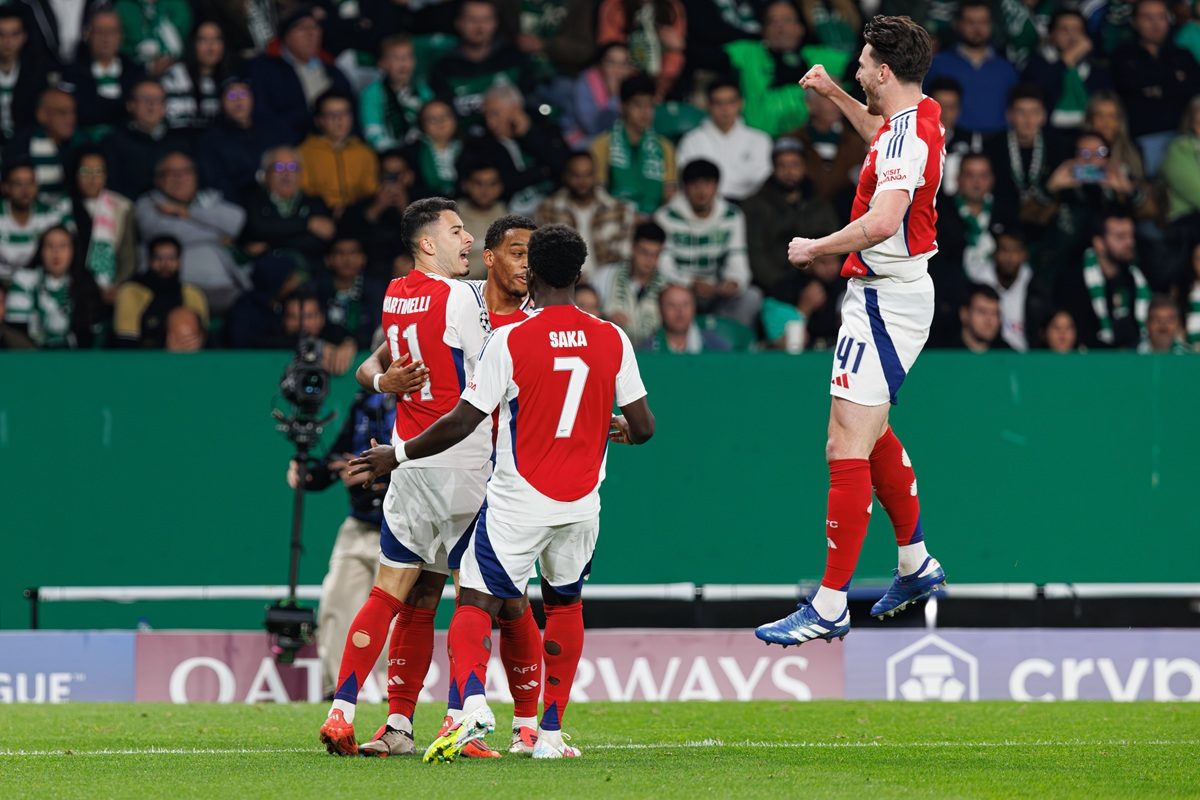
One third through the season, one team has broken away from the Premier League’s chaos: Arsenal. In an unpredictable season where reigning champions Liverpool are 8th, losing 3 of their last 5 games, and newly promoted Sunderland are 6th. The Gunners have provided ruthless consistency.
They sit 6 points clear over rivals Chelsea, and even more impressively, they have the 2nd most goals at 25 and an absurd defensive record – 7 goals conceded in 13 games. They also have the most 0 clean currents currently at 7. A monumental question is forming: can they surpass Chelsea’s iconic 2004/05 defensive record of 15 goals conceded and 25 clean sheets?
Simple math suggests they’ll fall short, but a deeper look into their advanced metrics reveals why this modern defence tells a different story.
Arsenal’s unprecedented defence
Arsenal’s defence is a masterclass at modern, proactive control. Their secret isn’t in last-ditch defence, but in stopping attacks before they form. Arsenal‘s xGA (Expected goals against) is 0.51 per match, the lowest by far. The next best team, Chelsea, is more than double at 1.03 per match.
They also have a Passes Per Defensive Action (PPDA) of 9.72, indicating an aggressive press (xGstat.com, 2025). Against Arsenal, oppositions have some of the lowest numbers of short, medium, and long passes completed per 90 minutes. This paints the complete picture: A unit that concedes nothing cheaply, wins possession quickly, and dominates the pitch at every distance.
In contrast, Chelsea 2004/05 conceded at a rate of 0.39 goals per game and in 13 games, conceded only 4 goals; 0.31 per game. Although the same metrics weren’t available during that time, their method is well-documented. Passive with the press, less dominant with possession, and won contested passes at all distances by controlling space and an unparalleled ability to win the ball back through positional dominance and long-range interceptions.
They conceded only 7 open play goals all season, the others being 1 penalty, 4 corners, 3 free kicks (Smith, 2025) by comparison. Arsenal has already conceded 4 open-play goals. The other 3 being a free kick against Liverpool, and corners against Newcastle and Chelsea.
As they are right now, Mikel Arteta’s Arsenal are at a historic pace. They can achieve the 3rd-fewest goals conceded, at 19, behind Arsene Wenger’s 98/99 Arsenal at 17 (Murray, 2025). To break Chelsea’s record, however, they must do more than maintain their modern aggression. They must match that squad’s legendary discipline and razor-thin margin for error.
From now on, they can only afford to concede just seven more goals all season, a monumental task that will define their campaign. After 13 games, Chelsea conceded 11 for the rest of the season, so Arsenal has some breathing space.
Shot prevention and goalkeeping.
How good is Arsenal at defending shots? Arsenal’s main keeper, David Raya, is jointly leading the Golden Glove race at 7 clean sheets, humorously shared with Chelsea’s Robert Sanchez, yet he averages only 1.54 saves per 90.
When analysing Raya’s individual performance, he has made 20 saves, 65% completed passes out of 390, 35% of long passes completed (out of 204) and a 75% save percentage. His stats indicate not only a keeper protected by an elite system but also a reliable keeper who keeps Arsenal from dropping points.
The way Arsenal defends shots is noteworthy, too. They have the 2nd least interceptions per match at 6.2, 3rd most possession won in the final 3rd at 4.1, 2nd least clearances at 2.1, 5th least tackles at 15.4, and make the least amount of saves at 1.4
This illustrates that low-quality Arsenal’s defence is very effective at preventing quality chances early, turning them into rushed, low-quality efforts. Despite dominating possession, they are successful in winning the ball back to prevent shots on their own goal. They’ve faced 27 shots on target, and out of those, 7 have been outside of the box.
How do they compare?
Chelsea’s 2004/05 team sets a near-impossible benchmark for sheer shot suppression. Since records began in 2003/04, that Chelsea team has faced only 83 shots on target – the joint-lowest among teams, alongside Guardiola’s 18/19 Manchester City.
Behind them, goalkeeper Petr Čech delivered an 87.5% save percentage and made 65 saves overall. As well as completing 34% (Out of 835) of his long passes. Most notably, this was the season Čech broke the record for most clean sheets in a season, 24. A record that still stands today.
This comparison highlights a critical philosophical divide. While Arteta’s Arsenal is designed to prevent the creation of chances, Mourinho’s iconic Chelsea was engineered to avoid converting the few chances that materialised. Interestingly, Arsenal’s proactive system may be more dominant overall, even if their goals conceded tally is currently higher.
For Arsenal to surpass this record, the path is simple yet immensely difficult. Their current concession rate of 0.5 goals per game must drop below 0.35 for the remaining 26 matches. This requires not just maintaining their aggressive press but achieving virtually flawless defensive execution every single week.
The last factor: Individual brilliance
The final element of a historic defence is individual quality, and Arsenal has been fantastic. Arsenal typically plays 4 at the back, and their main defenders from LB-RB are: Riccardo Calafiori/Myles Lewis Skelly, Gabriel Magalhães, William Saliba, and Jurian Timber.
These 5 stand out: the team has the league’s highest interception rate and won the most aerial duels, with Timber ranking fifth for tackles, underscoring their ability in one-on-one duels. Their discipline is also elite: they are one of only four teams yet to concede a penalty and have received the third-fewest yellow cards (18), with zero red cards.
Mourinho’s Chelsea, however, continues to set the benchmark for defensive cohesion. While they received 54 yellows, the 8th most of the season, they were one of three teams – along with rivals Tottenham and Arsenal – to not receive a red card. Their legendary back four of Ferreira, Carvalho, Terry, and Gallas—deployed in a revolutionary 4-3-3 (Vishnu Anandraj, 2020) — functioned as a single, intelligent organism.
They mastered the art of defending space. A tactical shift away from the era’s predominant man-marking, showing the English world that a unit’s collective intelligence can be even greater than the sum of its outstanding parts.
What does this mean for Arsenal?
It reveals the final, non-negotiable condition for success. They have the perfect system and players. Now, they must forge the unbreakable collective mentality that defined that all-time Chelsea team. The challenge is set in stone by mathematics. To break the record, they must concede no more than 7 goals in their last 26 games – a rate of 0.27 per game.
This transforms their task from mere tactical execution to psychological endurance. Every clearance, every offside trap, every tackle, every routine save now carries the weight of history. The final stretch is a test of relentless perfection, where one moment of lost focus can undo a season of brilliance. The numbers show that they are capable.
David Raya must continue his elite form. The settled back four must stay fit. The high press must not wane. The next four months will determine if they are historic.
This is a clash of defensive philosophies: Chelsea’s impenetrable fortress versus Arsenal’s proactive forcefield. The numbers prove Arsenal has built a historic defence so far. But Chelsea’s record demands more than talent—it requires an unbreakable mentality for 38 games. The quest isn’t just a title; it’s for immortality. Arsenal has the system. Now, they must prove they have the legendary consistency to rewrite history.